Introduction
The best multi touch attribution for coaches in 2026 is server-side, identity-resolved attribution that follows a prospect across every device and every touchpoint over a 30-day journey, not a browser cookie that expires in 24 hours. If you’re running ads for a coaching business and relying on the default Meta pixel, you’re flying blind. Full stop.
Here’s what this post covers. I’m going to walk you through why coaches specifically get burned by standard attribution, what’s actually happening under the hood with iOS 14+ and Safari’s Intelligent Tracking Prevention, and how a modern coaching funnel conversion API setup fixes the broken identity chain. I’ll also break down the real difference between tools like Hyros and Roaspy, show you how long funnel attribution works in a real coaching context, and explain why the Chrome extension workflow matters more than most people realize. By the end, you’ll have a clear picture of what attribution should look like for your business in 2026.
The ghost lead phenomenon: why your CRM and Ads Manager tell different stories
I call it the ghost lead problem.
You open your CRM on a Monday morning. There are 200 leads from the past two weeks. Calendly shows 40 discovery calls booked. Your closer tells you 12 people paid. But when you open Ads Manager? Zero conversions. Or maybe three. The number is so disconnected from reality it’s almost insulting.
This isn’t a fluke. It happens to nearly every coaching business I’ve worked with at some point. And when it happens, the knee-jerk reaction is to blame the ads. Panic sets in. Budgets get cut. Campaigns get killed. Campaigns that were actually working.
The real problem is the identity chain is broken.
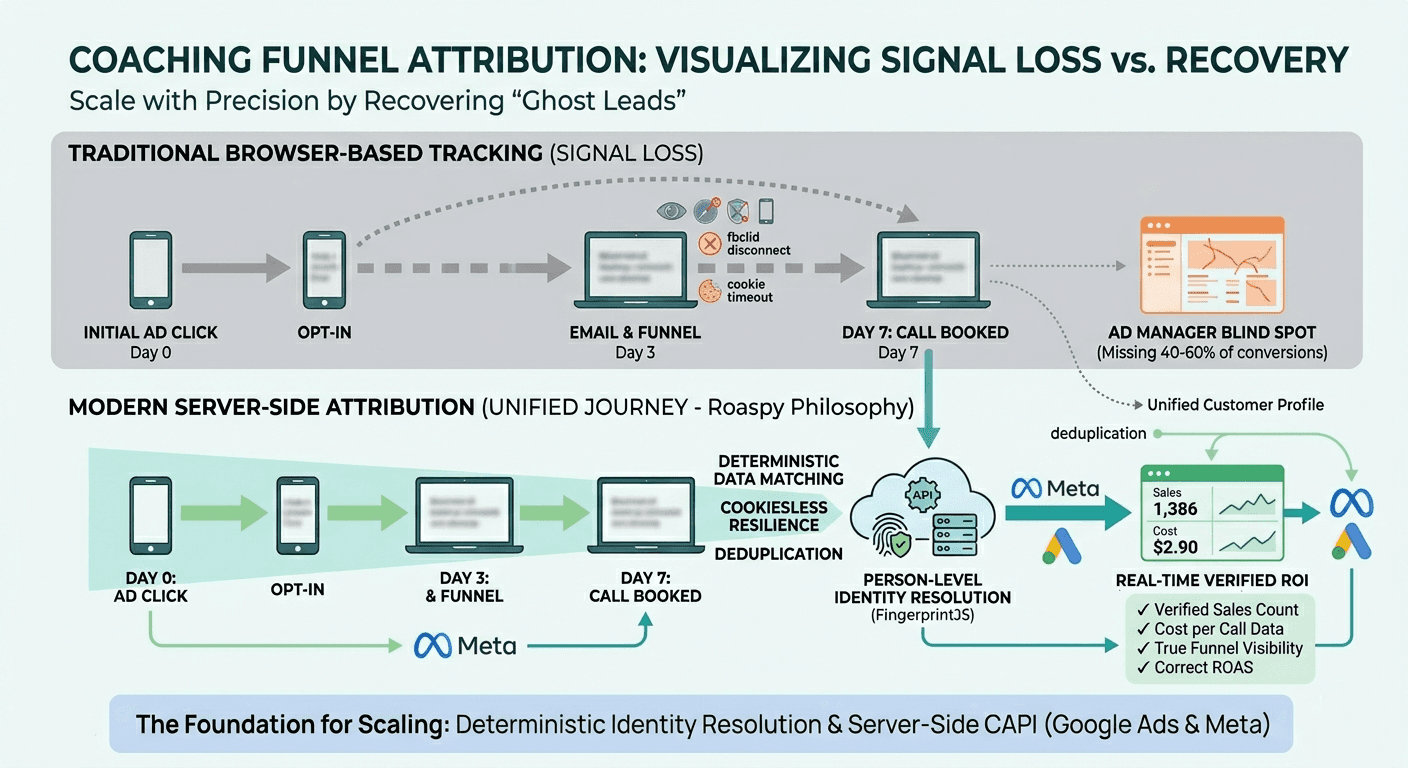
Here’s what I mean. Someone sees your ad on Instagram at 7 PM on their phone. They don’t buy. They go to bed. Two days later, they’re on their laptop, they search your name, they find your VSL, they watch the whole thing, they book a call. A week after that, they pay $5,000.
To your CRM, that’s a conversion. To Meta’s pixel, that person never existed after the first night. The cookie didn’t survive the device switch, the browser change, or the 72-hour gap. So Ads Manager shows zero, and you assume your ads aren’t working.
This is exactly why the best multi touch attribution for coaches 2026 isn’t just a nice-to-have. It’s the difference between scaling what works and cutting the campaigns that are quietly filling your pipeline.
Why last-click attribution is financial suicide for coaching businesses
Nobody in the coaching world has a one-touch funnel. Not at high ticket.
Think about the typical journey. A prospect sees a Facebook ad. They click, land on a free guide or webinar opt-in, and enter your email sequence. Over the next 7 to 21 days, they get nurtured. They watch a VSL. They see a retargeting ad. They read case studies. They lurk in your Facebook group. Then they book a call.
Last-click attribution looks at that entire journey and gives 100% of the credit to whatever happened right before the calendar booking. Usually, it’s a direct visit or a branded search. So your email sequence looks worthless. Your top-of-funnel Facebook ad looks worthless. And your retargeting campaigns look like they’re doing all the heavy lifting, even though they’re only closing people who were already warmed up by everything else.
I’ve seen coaches slash their awareness campaigns because “they weren’t converting,” only to watch their retargeting volume dry up completely within 30 days. Then they come to me confused about why their pipeline went cold. The awareness campaign was feeding everything downstream. They just couldn’t see it.
This is why long funnel attribution matters so much for coaches specifically. A $5,000 to $20,000 coaching program doesn’t get sold in one session. The decision takes days, sometimes weeks. The prospect needs to trust you, believe in the outcome, and feel ready. Every single touchpoint along that path contributed to the close. Giving all the credit to the last click is like letting your closer take 100% of commission while your marketing team quits.
Honestly, last-click is fine for e-commerce impulse buys. For high-ticket coaching? It’s actively misleading.
The 2026 reality: iOS 14+, Safari ITP, and the death of the 30-day cookie
Here’s the technical reality that most coaches (and a lot of marketers) still don’t fully grasp.
Safari’s Intelligent Tracking Prevention has been quietly killing third-party cookies since 2017. By 2026, even first-party cookies on Safari are capped at 7 days in many scenarios, and in some cases, just 24 hours for cookies set via JavaScript redirects. iOS 14+ gave users opt-out choices that tanked Meta’s signal quality almost overnight. Combine those two things, and you’ve got a world where a standard browser pixel is genuinely broken for anyone running a multi-day coaching funnel.
The practical impact: if your prospect doesn’t convert within roughly one day of clicking your ad, the pixel loses them. They become invisible. Your long funnel attribution collapses. Your ROAS data becomes fiction.
The solution isn’t to panic or abandon paid ads. The solution is to move attribution off the browser and onto the server. That’s what a coaching funnel conversion API does. Instead of relying on a JavaScript pixel in someone’s browser (which can be blocked, expired, or ITP’d into oblivion), you send conversion data directly from your server to Meta or Google’s servers. It bypasses browser restrictions entirely.
When you pair server-side CAPI with proper identity resolution, you can match a lead who clicked your ad on their iPhone last Thursday to the same person who just booked a call on their MacBook this afternoon. The match happens via email address, phone number, or a fingerprinting layer, depending on the tool you’re using.
This is table stakes for coaches running paid traffic in 2026. If your attribution setup doesn’t include a working coaching funnel conversion API, you’re making campaign decisions based on phantom data.
Server-side identity resolution: how to track coaching sales cross-device
To properly track coaching sales cross-device, you need three things working together.
First, you need a persistent identity attached to each lead the moment they opt in. That means capturing an email address or phone number early in the funnel and using it as the anchor identity. Every subsequent touchpoint, whether it happens on a different device, a different browser, or two weeks later, gets tied back to that anchor.
Second, you need a technology layer that can resolve identity even before the opt-in. This is where FingerprintJS-based tracking comes in. It creates a probabilistic device fingerprint that can identify returning visitors even when cookies are wiped. So if someone visits your sales page on Monday without opting in, then comes back Thursday and joins your list, those two sessions can be stitched together retroactively. That’s the missing link for most long funnel attribution setups.
Third, you need that identity data flowing through your coaching funnel conversion API back to Meta and Google. This closes the loop. Meta doesn’t just record that a conversion happened; it understands which original ad, audience, and creative started the journey. That’s what improves your campaign optimization over time.
I spent a long time wrestling with this cross-device problem at my agency. We’d have coaching clients with incredible call-close rates, but their ad accounts looked like they were burning money because attribution was shattered. Learning how to track coaching sales cross-device properly changed how we managed budgets, scaled winners, and justified spend to clients.
Most tools in this space handle pieces of this problem. Very few handle all three layers out of the box.
Long funnel attribution in practice: mapping the 30-day coaching journey
Let me make this concrete. Here’s a simplified version of what a real coaching funnel looks like when you actually map the touchpoints:
Day 0: Prospect sees a Facebook ad, clicks, lands on a free webinar opt-in page. Doesn’t register yet.
Day 1: Sees a retargeting ad on Instagram. Registers for the webinar.
Day 3: Watches the webinar replay via email link on their laptop.
Day 5: Receives a follow-up email with a VSL link. Watches 80% of it.
Day 8: Sees another retargeting ad with a testimonial. Clicks to your sales page. Doesn’t book.
Day 11: Gets an email with a limited spots message. Books a call.
Day 14: Discovery call happens. Pays $8,000.
In a last-click world, that $8,000 is credited to the email on Day 11, or maybe to whatever ad they saw on Day 8. Everything before that is invisible.
In a proper long funnel attribution setup, you can see that Day 0 Facebook ad started this whole journey. You can see which webinar sequence drives the highest-value leads. You can see that the VSL on Day 5 is the real conversion engine, because people who watch more than 70% of it are five times more likely to book.
That’s the kind of intelligence that lets you scale. Not the last-click number.
The best multi touch attribution for coaches 2026 doesn’t just record conversions. It reconstructs the entire journey, so you know exactly which touchpoints to invest in and which ones are optional.
Roaspy vs Hyros for coaches: which tool actually solves the attribution problem
This is the comparison most coaches eventually land on, so let me give you my honest take.
Hyros has been positioning itself as the go-to attribution tool for coaches and info-product creators for a few years now. It’s not a bad tool. But there are real limitations worth understanding, especially in 2026.
On pricing: Hyros pricing is based on monthly tracked revenue, and it’s publicly available on their site. It starts at $230/month for up to $20,000 in tracked revenue.As your revenue scales, the plans increase to $353/month for $40k, $583/month for $83k, $999/month for $250k, and $1,499/month for $750k. Above $1M in tracked revenue, pricing becomes custom.All plans include the full feature set and a dedicated analyst, but you do need to book a demo call to sign up. There’s no free trial, although they do offer a 30-day money-back guarantee.
Roaspy has a free plan for up to $1,500 in monthly ad spend. The paid Standard plan starts at $47/month and scales transparently based on your usage. Every plan includes the full feature set CAPI, Chrome extension, fingerprinting, and long-funnel attribution. There are no gated features. That’s genuinely rare in this space.
Here’s a comparison of what matters most for coaches:
Feature | Roaspy | Hyros |
Starting Price | $47/month | $230/month (monthly) |
Free Trial | Free up to $1500 ad spend | 30-day money-back guarantee |
CAPI (Meta & Google) | Included on all plans | Available (plan dependent) |
Full-Funnel Tracking | All plans | Available |
Chrome Extension (Ads Manager View) | Yes | No |
FingerprintJS Identity Resolution | Yes | No |
Gated Features | None | Some features tier-gated |
Built for Coaches/Info-Products | Yes | Yes |
Tech Stack | Modern React/JS | Legacy |
The Chrome extension point is one I genuinely care about. When you’re a solo coach or running a small team, you don’t have time to bounce between five dashboards. Roaspy’s extension puts the multi-touch truth directly inside your Ads Manager. You can see which ad started the journey that ended in a $5,000 close, without leaving Meta. That’s a workflow advantage that matters when you’re time-poor.
When comparing Roaspy vs Hyros for coaches, the FingerprintJS layer is the other big differentiator. Hyros does strong email-based tracking. But the probabilistic device fingerprinting that Roaspy uses means you’re capturing cross-device journeys even before a lead enters your email list. For long funnel attribution across 30 days, that’s a meaningful difference.
To be fair, Hyros has a more established brand and some coaches swear by it. But when I look at the combination of modern tech, transparent pricing with no gated features, and the coaching funnel conversion API integration across all plans, Roaspy wins for my use cases.
How Roaspy fits into this
I started using Roaspy because I was frustrated. Seriously frustrated.
I had coaching clients with profitable funnels, but their Ads Manager data was so broken that every budget conversation became an argument. We knew the ads were working because money was coming in. We just couldn’t prove which ads were doing the work. And when you can’t prove it, scaling becomes guesswork.
Roaspy solved two specific problems for me. First, the coaching funnel conversion API integration actually worked without a four-week engineering project. It sends clean, matched conversion data back to Meta and Google, which means the platforms’ own optimization engines get better signal and start finding better buyers. Second, the Chrome extension changed how I review campaigns. Instead of exporting data, cross-referencing it with Stripe and Calendly, and building manual attribution tables, I just open Ads Manager and the attribution data is right there.
What makes Roaspy genuinely different from the field? Three things. The FingerprintJS layer for cross-device identity. The zero feature gating across all plans (the $47/month Basic plan has everything). And the speed of the reporting, which runs on a modern React and JavaScript stack rather than the sluggish legacy infrastructure that older tools are still dragging around.
For coaches who are managing their own ads or working with a small media buyer, this is the tool I recommend. Not because it’s the most famous name in the space, but because it’s actually built for the problems coaches face in 2026.
Try now at https://roaspy.com. No credit card required to see whether it fits your funnel.
Frequently asked questions
Q: What’s the difference between first-touch, last-touch, and multi-touch attribution for coaching funnels?
A: First-touch gives 100% credit to the ad or channel that originally brought someone into your world. Last-touch gives all the credit to whatever happened right before they paid. Multi-touch spreads the credit across every interaction in between, so you can see which parts of your funnel are actually doing the work. For coaches with 10 to 30-day buying journeys, multi-touch is the only model that gives you a complete picture.
Q: Does a coaching funnel conversion API actually improve Meta ad performance, or just reporting?
A: Both. When you send accurate conversion data back to Meta via CAPI, the algorithm gets better signal to optimize against. It finds more people who look like your actual buyers instead of guessing based on incomplete pixel data. So yes, better attribution reporting is part of it, but improved campaign performance over time is the real payoff.
Q: Is Roaspy vs Hyros for coaches really a meaningful comparison, or are they basically the same?
A: They’re solving the same core problem but with different approaches. Hyros is established and email-tracking focused. Roaspy uses FingerprintJS for probabilistic cross-device identity resolution, has a Chrome extension that surfaces attribution data inside Ads Manager, and doesn’t gate any features behind higher plans. For coaches who want modern tech without paying enterprise prices, the Roaspy vs Hyros for coaches comparison lands pretty clearly in Roaspy’s favor.
Q: How long does it take to properly set up long funnel attribution for a coaching business?
A: Honestly, a basic setup with pixel, CAPI integration, and a funnel connected to your CRM or booking tool can be done in a day. Getting clean long funnel attribution across all your touchpoints, email sequences, and cross-device journeys takes a bit more configuration, maybe a week to dial in properly. Tools like Roaspy are built to minimize the technical lift for small teams.
Q: Can I track coaching sales cross-device without having developer resources?
A: Yes, if you choose the right tool. Roaspy is specifically designed for coaches and info-product businesses without dedicated engineering teams. The CAPI integrations and FingerprintJS tracking are handled at the platform level. You don’t need to write code to track coaching sales cross-device properly.
Q: Does multi-touch attribution work if my prospects are going through a long email sequence before booking?
A: Yes, and this is exactly where it shines. When your coaching funnel conversion API is properly configured, every email click, page visit, and VSL view gets logged against the lead’s identity. By the time they book a call, you have a full map of which messages, pages, and ads moved them forward. That’s the entire point of the best multi touch attribution for coaches 2026.
My final thoughts
Here’s the honest truth about attribution for coaches in 2026. Most of the pain coaches feel around ad performance isn’t actually an ads problem. It’s a measurement problem. The campaigns are often working. The funnel is often converting. But because the data is broken, the decisions being made are wrong. Budgets get pulled. Good campaigns die. And the business stalls.
I’ve been in this space long enough to have watched this play out dozens of times. A coach with a profitable funnel, a broken Ads Manager, and growing panic about their ROAS number. The fix is rarely the ad creative or the targeting. The fix is fixing the attribution so you can see what’s actually happening.
Getting long funnel attribution right isn’t complicated once you understand the pieces. You need server-side CAPI. You need cross-device identity resolution. And you need the data surfaced somewhere you’ll actually look at it, which is why the Ads Manager Chrome extension matters more than it sounds. When you have all three, you stop flying blind. You start making decisions based on the full journey, not the last click.
If you’re a coach or you’re running ads for coaching businesses, I genuinely think the best multi touch attribution for coaches 2026 is within reach without a massive budget or an engineering team. Check out Roaspy, start the free trial, and see what your funnel actually looks like when the identity chain is intact.
You might be surprised how many ghost leads turn out to have been real buyers all along.