Introduction
The best tracking pixel for SamCart in 2026 is not a browser-side script you paste into a thank-you page. It’s a server-side solution that uses the Conversions API (CAPI) to fire events directly from the server, bypassing ad blockers, Safari’s Intelligent Tracking Prevention, and every other browser-level obstacle that quietly deletes your revenue data before it ever reaches Meta or Google. If you’re still relying on SamCart’s native pixel integration alone, you are almost certainly under-reporting conversions by 20 to 30 percent, and that gap is enough to make a winning campaign look like a money pit.
This article walks through exactly why that gap exists, why it gets dramatically worse when you add order bumps and one-click upsells to the mix, and what a proper tracking setup looks like for SamCart sellers in 2026. I’ll cover server-side tracking for SamCart, how SamCart Meta Conversions API and SamCart Google enhanced conversions work together, and why the choice between solutions like Roaspy vs Hyros for SamCart matters more than most people realize. By the end, you’ll know what to use and why.
Why SamCart’s native pixel breaks at the upsell page
SamCart is genuinely great at one thing above all else: the post-purchase upsell flow. The 1-Click Upsell is the whole reason info-product creators, coaches, and course sellers love it. You get a customer to buy the front-end offer, and then a sequence of upsell pages fires automatically. Done right, that flow can double your average order value without any friction for the buyer.
Here’s the problem. The native pixel fires on page load. Each upsell page is a separate URL. When the pixel is implemented the standard way, a purchase event fires on the checkout confirmation page, but the subsequent upsell pages don’t reliably trigger a second purchase event. Some setups catch it; many don’t. And even when they do, you’re counting on the browser to execute the script correctly every single time.
I’ve seen funnels where the front-end sale was tracked perfectly and every upsell was completely invisible to Ads Manager. The advertiser was optimizing for a $47 purchase when the real average order value was $180. Their campaigns were underperforming because the algorithm had no idea its best customers were also buying the $97 and $37 order bump on the backend.
This is not a SamCart-specific bug. It’s a fundamental limitation of browser-side pixels. The page changes, the browser moves on, and the script either fires correctly or it doesn’t. To properly track SamCart upsells, you need events that originate at the server level, not the browser level.
The 2026 privacy problem: Safari and iOS are ghosting your scripts
Even if your upsell tracking were set up perfectly on the browser side, you’d still be fighting a losing battle in 2026. Apple’s Intelligent Tracking Prevention (ITP) has been aggressively limiting first-party cookies since 2017. By now, it caps cookie lifespans at 7 days in Safari and in some configurations as short as 1 day.
On iOS, things are even tighter. Between App Tracking Transparency, link decoration stripping, and private browsing behavior, a significant portion of your buyers are essentially invisible to browser-based scripts the moment they land on your page. And SamCart’s customer base skews heavily toward consumers who buy courses, coaching programs, and digital products. That demographic buys on mobile. A lot.
What this means practically: if you’re running ads to a SamCart funnel and relying on browser pixels alone, a chunk of your conversions simply never report back to Meta or Google. The ad platform’s AI has less signal to work with. It can’t optimize toward your highest-value buyers. Your cost per acquisition drifts up. Campaigns that should be scaling stall out.
This is exactly why SamCart Meta Conversions API integration has gone from “nice to have” to “non-negotiable.” CAPI sends conversion data directly from your server to Meta’s servers, completely bypassing the browser. Safari can’t block it. iOS can’t strip it. It just works. The same logic applies to SamCart Google enhanced conversions, which passes hashed customer data back to Google via the server to fill in the gaps left by cookie loss.
Honestly, I should have moved to server-side tracking for SamCart setups two years earlier than I did. The improvement in data quality was significant enough that I kick myself every time I think about the campaigns we were half-flying blind on.
The checkout-to-OTO gap is costing you real money
Let me put a number on this. Industry estimates and my own experience running tracking audits on SamCart funnels consistently show that browser-based pixels under-report revenue by 25 to 35 percent when upsells are involved. Let’s say your funnel does $20,000 in a month. Your Ads Manager might show $13,000 to $15,000. You’re making decisions, including whether to scale or kill campaigns, based on data that’s missing a third of your actual revenue.
That’s not a rounding error. That’s campaigns getting paused because the ROAS looks like 1.8x when the real number is 2.7x.
The order bump is where this gets particularly bad. Order bumps are often a checkbox on the checkout page itself. Some pixel setups capture the order bump as part of the initial purchase event, with the correct value. Many don’t. The bump gets added to the order total server-side, but if your pixel fires before the form submits fully, you’re logging a purchase at the lower price.
To properly track SamCart upsells and order bumps, the event needs to originate after SamCart’s server has processed the full transaction. That means a webhook or a server-to-server API call. Not a page-load script. Not a GTM trigger. A proper server-side event.
SamCart does have a webhook system. You can push order data to a third-party platform that then fires the CAPI event on your behalf. But for most creators, “set up a webhook” triggers immediate anxiety. This is why the choice of tracking tool matters so much for SamCart users specifically.
What server-side tracking for SamCart actually means in plain English
I want to cut through the jargon here because this trips people up.
Browser-side tracking means: your pixel code lives in the page HTML. When someone visits the page, their browser runs the script, and it sends data to Meta or Google from the buyer’s device.
Server-side tracking for SamCart means: when a purchase happens, SamCart sends the transaction data to a tracking platform (via webhook or API). That platform then forwards the data directly to Meta or Google from a server. The buyer’s device is not involved in the data transmission.
Why does this matter? Because servers don’t have ad blockers. Servers don’t have ITP. Servers don’t lose cookies after 7 days. Server events arrive consistently, with full data, every time.
SamCart Meta Conversions API integration works by connecting SamCart’s webhook output to Meta’s CAPI endpoint. Every time SamCart processes a purchase, a server-side purchase event fires in Meta with the correct order value, including upsells and order bumps.
SamCart Google enhanced conversions works similarly. Transaction data including hashed customer email is sent to Google post-purchase, which Google uses to match conversions to ad clicks even when cookies are unavailable. Together, these two integrations are the foundation of any serious tracking setup for SamCart in 2026.
I covered some of this thinking in a video about small page and funnel changes that drive disproportionate revenue gains. Tracking isn’t the flashiest lever, but getting it right is one of the highest-ROI fixes you can make.
Roaspy vs Hyros for SamCart: an honest breakdown
When people are shopping for the best tracking pixel for SamCart, they’re usually looking at a handful of tools: HYROS, AnyTrack, ClickMagick, and increasingly Roaspy. Let me give you my honest take.
HYROS is the one everyone hears about first. It’s been around, it’s well-marketed, and for high-volume operations it does a solid job. But the pricing is aggressive. Their entry-level Business plan starts at $230/month (billed annually) for up to $20,000 in tracked revenue. Mid-tier runs $353 to $999/month for $40K to $250K in tracked revenue. If you’re doing $750K, you’re at $1,499/month. That’s a real cost, and it scales in a way that penalizes growth.
In the Roaspy vs Hyros for SamCart comparison, pricing alone changes the math for most info-product creators. If you’re doing $30K to $50K a month in SamCart revenue, you’re looking at $353 to $999/month just for HYROS. That’s before you’ve paid for your ads, your SamCart subscription (which starts at $79/month and increase to $109/month), or anything else.
AnyTrack has solid event mapping and postback capabilities. ClickMagick is reliable for click tracking and basic attribution. Both are respectable tools. But neither was built with the modern CAPI-first architecture that 2026 demands, and neither gives you the kind of full-funnel visibility inside your Ads Manager dashboard that I’ve come to rely on.
The Roaspy vs Hyros for SamCart question really comes down to: do you want enterprise pricing for enterprise features, or do you want enterprise-grade tracking at a price that makes sense for where you are?
How Roaspy fits into your SamCart workflow
This is the section where I’ll be upfront: I built Roaspy, so take that for what it’s worth. But I built it because I was frustrated with exactly the problems described above, and none of the existing tools solved them in a way that worked for how SamCart sellers actually operate.
Here’s what Roaspy does that matters specifically for SamCart.
Plug-and-play CAPI. Roaspy handles both SamCart Meta Conversions API and SamCart Google enhanced conversions through a clean server-side integration. You don’t need to build webhooks manually or hire a developer. It connects to SamCart’s order data and fires server-side events automatically. Every purchase, every upsell, every order bump, reported accurately.
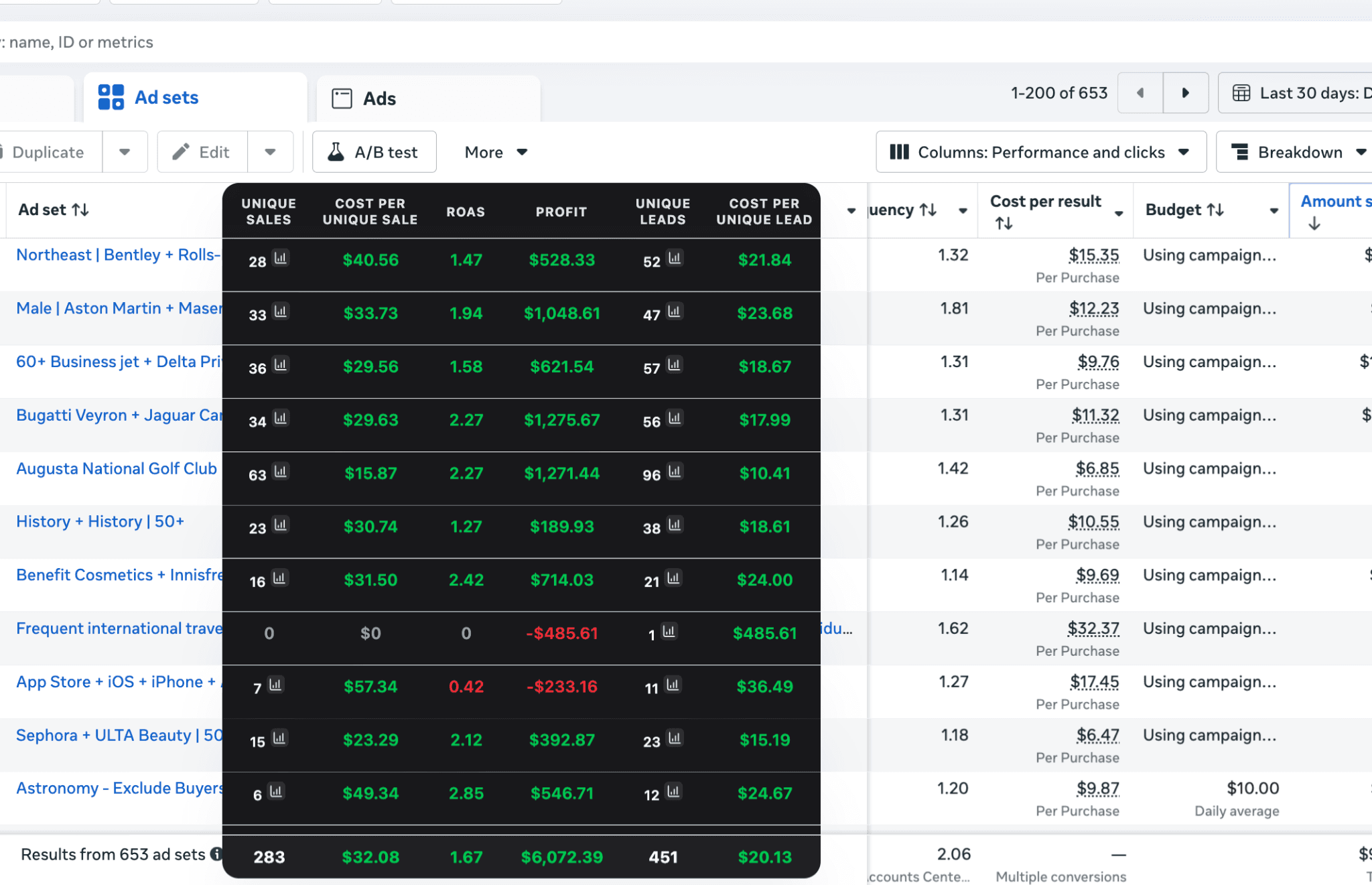
Chrome extension for Ads Manager. This one’s different. Roaspy has a Chrome extension that pulls your attribution data directly into your Meta Ads Manager interface. You can see real revenue attributed to each campaign without switching tabs or building reports. For creators who live in Ads Manager, this is genuinely useful.
FingerprintJS technology. Roaspy uses FingerprintJS for device-level identification, which means even when cookies are stripped or browsers are in private mode, Roaspy can still connect ad clicks to purchases. This directly closes the Safari and iOS gap that I described earlier.
No gated features. Every plan includes full-funnel tracking, CAPI for both Meta and Google, and the complete customer journey view. I’ve always believed that the tools that matter most shouldn’t be locked behind a premium tier.
For comparison, HYROS starts at $230/month. Roaspy is priced to be accessible without stripping out the features that actually matter. If you want to explore it yourself, head to roaspy.com.
Feature | Roaspy | HYROS |
Server-side tracking for SamCart | Yes | Yes |
SamCart Meta Conversions API | Yes | Yes |
SamCart Google Enhanced Conversions | Yes | Yes |
Chrome extension for Ads Manager | Yes | No |
FingerprintJS technology | Yes | No |
Gated features | No gating (All features included) | Feature-tiered access |
Entry-level pricing | $47/month(free upto $1500 ad spend) | $230/mo (up to $20K revenue) |
Best for | Creators, coaches, and agencies | High-volume/Enterprise advertisers |
When I compare Roaspy vs Hyros for SamCart, the decision for most creators I talk to is clear. HYROS makes sense if you’re at seven figures in monthly revenue and need enterprise-level support. Below that, you’re overpaying for features you won’t use, and you’re still not getting the Chrome extension or the FingerprintJS layer.
Frequently asked questions
Q: Can SamCart’s native pixel handle upsell tracking on its own?
A: Not reliably. SamCart’s browser-side pixel fires on page load, and upsell pages are separate URLs. In practice, many upsell purchases either don’t fire a second purchase event or fire with the wrong value. To properly track SamCart upsells, you need server-side events triggered by SamCart’s webhook system, not page scripts.
Q: Is SamCart Meta Conversions API hard to set up without a developer?
A: It depends on the tool you use. Setting up SamCart Meta Conversions API manually through Facebook’s Business Manager requires some technical steps, including configuring webhooks and mapping event parameters. Tools like Roaspy simplify this into a guided integration that most non-technical creators can complete without touching code.
Q: How much of a difference does server-side tracking for SamCart actually make?
A: In my experience, switching from browser-only to server-side tracking for SamCart typically recovers 20 to 35 percent of missing conversion data. The bigger your upsell sequence, the larger the recovery. Campaigns that looked unprofitable sometimes turn out to be strong performers once the full revenue picture is visible.
Q: What makes Roaspy different from HYROS for SamCart sellers specifically?
A: When comparing Roaspy vs Hyros for SamCart, the most practical differences are pricing structure and the Chrome extension. HYROS charges $230/month at entry level and scales up aggressively with revenue. Roaspy offers full-funnel tracking and CAPI on all plans without gating features. The Chrome extension that shows attribution data inside Ads Manager is also something HYROS doesn’t offer.
Q: Does SamCart Google enhanced conversions work the same way as Meta CAPI?
A: The concept is the same: server-side data sent after a purchase to fill in gaps left by cookie loss. SamCart Google enhanced conversions specifically passes hashed customer data (usually email) to Google, which matches it against signed-in Google users to attribute conversions that cookies missed. It pairs well with SamCart Meta Conversions API as a dual-platform server-side setup.
Q: Do I still need a browser-side pixel if I’m using server-side tracking for SamCart?
A: Yes, you should run both. The browser-side pixel handles real-time events like page views, add-to-carts, and initiate checkouts that help train the ad platform’s algorithm. Server-side tracking for SamCart covers the purchase and post-purchase events accurately. Running both gives you better deduplication and stronger overall signal quality.
My final thoughts
If there’s one thing I want you to take away from this, it’s that your tracking setup is a business decision, not a technical afterthought. I’ve watched advertisers spend $10,000, $20,000, even $50,000 a month on ads while flying blind on attribution because they assumed their pixel was “working fine.” It wasn’t. It was quietly dropping 30 percent of their revenue data every single day.
SamCart is a great platform for creators. The upsell mechanics are genuinely powerful. But that power only works for your ad campaigns if your tracking can see the full picture. Browser-side pixels can’t do that in 2026. Safari blocks them. iOS ignores them. And your upsell pages were never designed to be reliably tracked by page-load scripts in the first place.
The combination of SamCart Meta Conversions API and SamCart Google enhanced conversions, running through a proper server-side integration, is the answer. It’s not complicated. It doesn’t require a developer. It just requires choosing the right tool and spending 30 minutes setting it up correctly.
Finding the best tracking pixel for SamCart really comes down to one question: do you want to make decisions based on 65 percent of your data, or all of it? I know which one I’d pick.
If you’re running ads to a SamCart funnel and want to see what you’re actually missing, try Roaspy at roaspy.com. It takes minutes to connect and you’ll see the gap immediately. Stop optimizing against incomplete data. Your campaigns will thank you.


