Introduction
If you want to know how to run Facebook ads for digital products in 2026, here is the direct answer: your profitability does not come from the front-end sale. It comes from what happens in the 90 seconds after checkout. Order bumps, one-time offers, upsell pages. That sequence is where many digital product funnels generate a large share of their revenue, and if your tracking can’t capture every step of it, Meta’s algorithm is flying blind. You will turn off winning campaigns because the numbers look bad, when in reality your pixel may have missed a significant portion of the revenue attribution.
In this post, I’m going to walk through the full picture: what a high-margin digital product funnel actually looks like in 2026, why browser-based pixels can become unreliable during fast multi-step checkouts, and what you can do about it. I’ll cover the mechanics of how to run Facebook ads for digital products correctly, how to think about AOV-driven scaling, and the digital product funnel tracking software that I personally use and trust. If you’re selling ebooks, courses, templates, or any info product and you’re running paid traffic, this is the piece I wish I’d had two years ago.
The funnel leak problem nobody wants to admit
Here’s something I see constantly. Someone builds a solid ebook funnel. Front-end offer at $27. Order bump at $17. OTO at $97. On paper, average order value should be sitting around $65 to $70 when everything fires. But their Meta dashboard shows an average purchase value closer to $30. So they cut the ad spend, call the campaign unprofitable, and move on.
The campaign was profitable. Their tracking just didn’t see it.
This is the core problem with running paid traffic to digital products in 2026. Browser-based tracking can be fragile. A user clicks through an order bump in under three seconds. Another user closes the upsell tab before the confirmation fires. A third is on a slow mobile connection and the page times out mid-load. In each case, the purchase event either doesn’t fire or fires with incomplete value. When you’re trying to track info product order bumps on Meta, this isn’t an edge case. It can happen frequently on funnels handling meaningful traffic volume.
I used to think pixel misfires were a minor annoyance. A rounding error. I was completely wrong. When you lose 20 percent of your conversion value reporting, you’re not losing 20 percent of your insight. You’re corrupting the entire signal Meta uses to find your next buyer. The algorithm trains on what it sees. If it sees low-value purchases, it goes out and finds low-value customers. You end up in a death spiral of rising CPAs and shrinking ROAS that feels mysterious, but it’s actually mechanical.
Honestly, this is where I see the gap between info product marketers who scale and those who stall.
Why AOV is everything and your pixel is lying to you
Most paid traffic advice focuses on front-end CPA. Get your cost per purchase below your product price and you’re winning. That logic works fine for single-product e-commerce. For digital product funnels, it’s almost irrelevant.
If you’re trying to sell ebooks with Facebook ads 2026, your ebook is not your product. It’s your customer acquisition vehicle. The real product is the upsell stack. I’ve worked with funnels where the front-end offer barely covered ad costs, but the backend turned every customer into a $90 to $120 order on average. At scale, that math is extraordinary.
The problem is that to run this kind of funnel profitably, Meta needs to see the full purchase value. Every. Single. Time. When you’re relying on a browser pixel to track multi-step checkouts, that’s not what happens. TBrowser-based tracking may miss a meaningful percentage of events, especially in multi-step checkout environments. On a high-traffic day with server load, it’s worse. And when Meta’s algorithm is optimizing on that incomplete data, it can’t identify the specific audience segments that actually complete the upsell flow.
I spent three months convinced a particular campaign was underperforming. Turned out it was one of my best. The pixel was quietly missing a big chunk of order bump completions because users were clicking through so fast the event script hadn’t finished loading. That’s not necessarily a targeting problem. It’s often an attribution and tracking problem.
The fix isn’t a creative refresh. It’s attribution infrastructure.
How to run Facebook ads for digital products without bleeding your budget
Let’s get practical. When I think about how to run Facebook ads for digital products in 2026, my framework has three layers: offer architecture, audience sequencing, and reliable server-side event tracking.
Offer architecture means your funnel is structured to maximize AOV before someone leaves the checkout environment. Order bump on the checkout page. An immediate OTO after purchase. A downsell if they decline. This isn’t new. But what’s changed is that in 2026, Meta’s Advantage+ campaigns are increasingly running the show on delivery, which means your job is to give the algorithm the cleanest possible purchase signal to work with.
Audience sequencing is simpler than people make it. Broad cold audiences with strong creative, retargeting with proof-based content, and lookalikes built from your highest-AOV purchasers (not just any purchasers). If you want to sell ebooks with Facebook ads 2026 at scale, that lookalike pool matters enormously. But only if it’s seeded with verified, server-confirmed purchase events.
This is where server-side CAPI becomes non-negotiable. Browser-only signals are often insufficient for accurate attribution in 2026, between iOS tracking restrictions, browser privacy settings, and the sheer speed of multi-step checkouts. If you want to track info product order bumps on Meta accurately, you need events firing from your server to Meta’s API, not from a JavaScript snippet running in someone’s browser tab.
Sell ebooks with Facebook ads 2026: what the funnel actually looks like
I want to paint a real picture here because most breakdowns I read are too abstract.
You’ve got a $19 ebook. Someone clicks your ad, lands on a simple VSL or long-form sales page, and buys. That’s a $19 event. Then immediately, before they hit the thank-you page, they see a one-click order bump: a companion workbook for $15. If they take it, that’s $34. Then they’re redirected to an OTO: a mini-course for $67. Some take it. Some don’t. A percentage might see a downsell at $37.
If your pixel only catches the initial $19 purchase, your reported ROAS looks terrible. You’re reading a $19 average purchase value when your real AOV might be $48 or $55. To sell ebooks with Facebook ads 2026 profitably, you need every dollar in that sequence reported back to Meta with high event match quality.
When you’re trying to track info product order bumps on Meta at the velocity that a mid-scale campaign generates, browser pixels were not originally designed for fast multi-step funnel attribution. They were designed for slower, single-step e-commerce checkouts. Digital product funnels move faster. Users click quickly. Pages load and unload.JavaScript events can fail, overlap, or get interrupted.
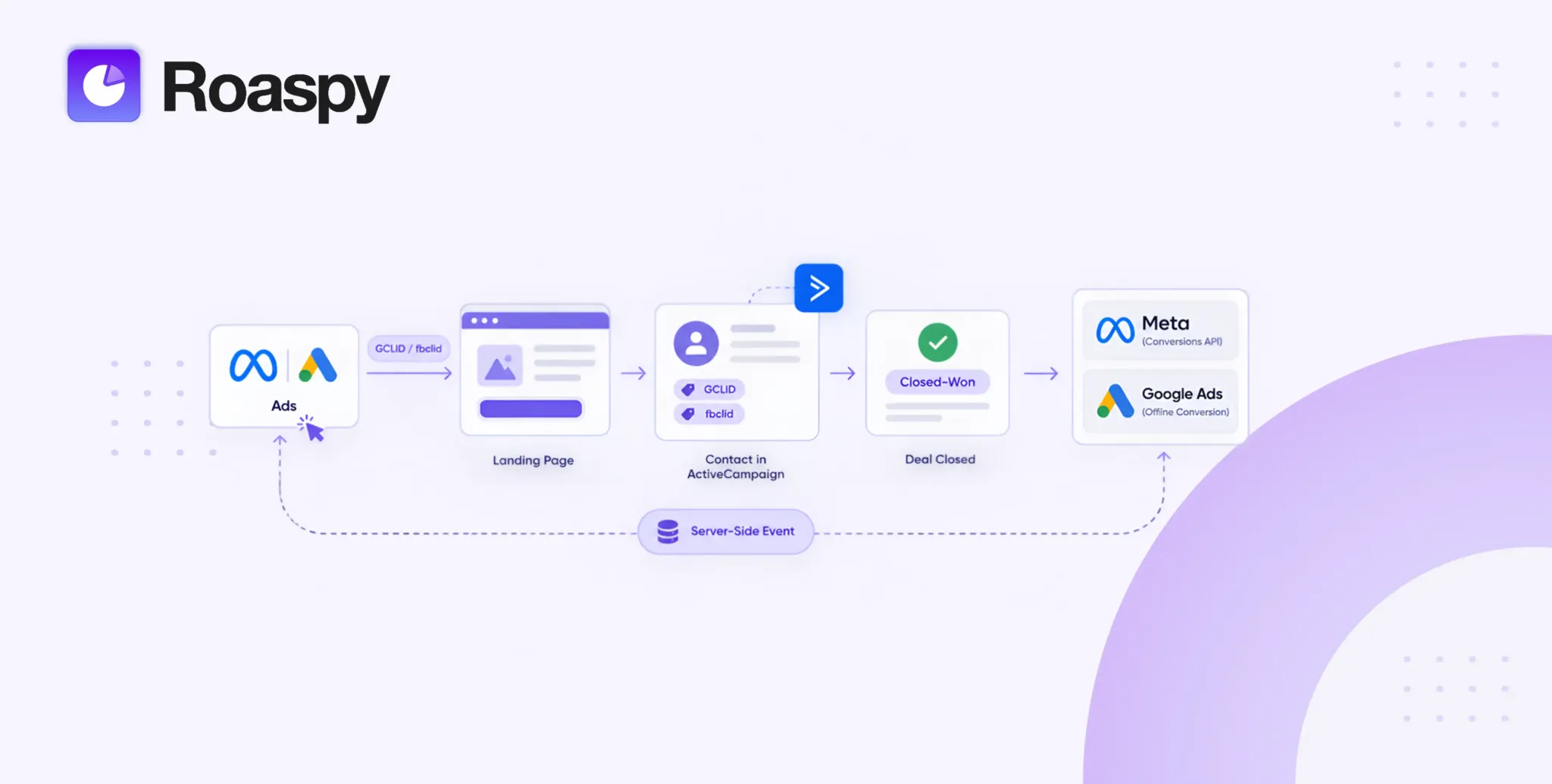
The solution is what I’d call a database-level capture approach. Instead of waiting for a browser event to fire, your checkout platform fires a webhook to an attribution system the moment a transaction completes at the database level. That event is then pushed to Meta’s CAPI. It’s generally more reliable because it doesn’t rely entirely on browser behavior.
Track info product order bumps meta: the missing piece of your attribution stack
If there’s one thing I want you to take from this piece, it’s this: your ability to track info product order bumps on Meta is the single highest-leverage thing you can fix in your entire paid traffic setup right now.
Here’s why. Meta’s algorithm is heavily driven by conversion-value optimization. You tell it what a conversion is worth. It finds more people who look like those converters. If your conversion data is noisy, partial, or delayed, the machine finds the wrong people. Simple as that.
When you implement proper server-side tracking, a few things happen immediately. Your Event Match Quality score goes up. This is Meta’s internal score for how confident it is that the purchase event you’re sending matches a real Facebook user. Higher EMQ means the algorithm can attribute and optimize more accurately. I’ve seen campaigns where EMQ went from 5.1 to 8.3 after switching to server-side, and I’ve seen cases where CPA improved within a few weeks after fixing event quality. Not from changing creative. Not from restructuring audiences. Just from fixing the data.
Another common outcome is that reported ROAS improves because previously missed events are now being captured, because you’re now capturing events you were previously missing. This looks like performance improving, but really you’re just seeing the true performance that was always there.
Most people I talk to who are using good digital product funnel tracking software for the first time have this same reaction: “Wait, this campaign was actually profitable this whole time?”
Yes. It was.
Roaspy vs Hyros for digital products: which one actually solves the problem
This comes up constantly, so let me be direct. When people ask about Roaspy vs Hyros for digital products, they’re usually asking the wrong question first. The question isn’t “which has more features.” It’s “which one was actually built for how digital product funnels work.”
Hyros is a solid tool. It’s well-known, well-marketed, and works reasonably well for certain business models. But its pricing is based on tracked monthly revenue tiers, starting at $230/month for up to $20k in tracked revenue and climbing to $999/month at higher revenue bands. A lot more. For an info product business doing consistent volume, that revenue tax adds up fast.
The other issue with Hyros in the context of Roaspy vs Hyros for digital products specifically is that it is a broader attribution platform rather than a tool specifically focused on multi-step digital product funnels. That architecture, the kind you’re running when you sell ebooks with Facebook ads 2026 through a ThriveCart or SamCart funnel, requires something that can aggregate total order value across multiple sequential transactions tied to the same customer journey within minutes.
Feature | Roaspy | Hyros |
Pricing Model | Free (up to $1,500 ad spend) / $47/mo | Starts at $230/mo, revenue-tiered |
Order Bump & OTO Aggregation | Native, built-in (Maintains data stack continuity) | Limited / Requires complex custom workarounds |
Server-Side CAPI | Native & immediate (Direct server-to-Meta API) | Available, but complex and onboarding-heavy |
Inline Ads Manager Overlay | Yes (Live ROI data via Chrome Extension) | No (Requires a separate open dashboard tab) |
30-Day Sticky Journey Mapping | Yes (Stitches long-cycle lead data to backend closes) | Partial (Relies heavily on broad multi-device profiling) |
EMQ Enrichment | Yes (Automates first-party hashing on every event) | Partial (Requires advanced, tier-dependent setup) |
Checkout Webhook Syncing | Automated (Zero-code pipeline integration) | Manual backend configuration required |
Best For | Digital product funnels, course creators, boutique agencies | High-volume enterprise media buyers with massive scale |
When comparing Roaspy vs Hyros for digital products, that table tells you most of what you need to know. One was built around this exact use case. The other wasn’t.
Why I recommend Roaspy for digital product funnel tracking software
I started using Roaspy after a particularly frustrating quarter where my reporting and my actual bank balance couldn’t seem to agree. I knew revenue was coming in. Meta was telling me campaigns were barely breaking even. Something was off.
What Roaspy does, at a fundamental level, is act as the source of truth for your entire checkout sequence. It is designed to capture transactions across the funnel, order bump, and post-purchase upsell at the database server level, using checkout webhooks that fire the moment a transaction is recorded. Not when a browser event loads. Not when a confirmation page renders. When the actual transaction hits the database.
That data feeds into Meta via native server-side CAPI, with full EMQ enrichment. And then, through a Chrome extension, it overlays your true ROAS and net profit directly inside Meta Ads Manager. You don’t switch tabs. You don’t export CSVs. You look at your dashboard and you see what’s actually happening.
This is what separates it from other digital product funnel tracking software I’ve used. Most attribution tools focus primarily on purchase events, while Roaspy places heavier emphasis on multi-step customer journeys. Its 30-day customer journey mapping means if someone buys your front-end offer today and comes back three days later to grab an upsell, that revenue is still attributed correctly.
Roaspy pricing model that is completely free for up to $1,500 in monthly ad spend, after which it costs a $47 per month. No revenue percentage. That single detail matters enormously once you’re scaling. I’ve looked at what Hyros would cost at various revenue levels and the number gets uncomfortable fast.
If you’re serious about learning how to run Facebook ads for digital products correctly in 2026, fixing your attribution is step one. You can start exploring Roaspy at https://roaspy.com/.
Frequently asked questions
Q: Do I need server-side tracking if my digital product funnel is small?
A: Honestly, yes, even at lower volumes. The issue isn’t scale, it’s data quality. If Meta’s algorithm is training on incomplete purchase values from day one, you’re building on a bad foundation. Better to set it up correctly early than to try to correct corrupted optimization data later.
Q: Can I use Roaspy with any checkout platform?
A: Roaspy connects via automated checkout webhooks, which means it works with the major platforms used for digital products (ThriveCart, SamCart, and similar). The integration is designed to capture transaction data at the source, so it doesn’t rely on your checkout platform’s native pixel implementation.
Q: How is Roaspy vs Hyros for digital products different in practice?
A: Roaspy is purpose-built for multi-tier digital product checkouts with order bumps and OTOs. Hyros is a broader attribution tool. The practical difference is that Roaspy natively aggregates the full order value across a checkout sequence and was designed specifically for funnels where the AOV is assembled across multiple rapid steps, which is exactly how most info product funnels work.
Q: Why does my Meta ROAS look so different from my actual revenue?
A: Almost always, it’s pixel dropout. Browser pixels miss events when users move through checkout fast, close tabs early, or experience slow connections. The reported purchase value is lower than reality because partial events are being sent to Meta. Server-side CAPI can significantly reduce this issue by capturing transactions at the database level, independent of browser behavior.
Q: Is it still worth running Facebook ads for digital products in 2026 given increasing CPMs?
A: Yes, because digital products have margins that physical products can’t match. When you sell ebooks with Facebook ads 2026 and your product costs essentially nothing to deliver, a $30 to $50 CPA on a $19 front-end offer is still profitable once the backend fires. The math only works if your tracking is capturing the full AOV, though.
Q: What’s Event Match Quality and why does it matter for digital product campaigns?
A: EMQ is Meta’s score (1 to 10) for how reliably it can match your conversion events to actual Facebook users. Higher EMQ means the algorithm can optimize more precisely. Poor server-side implementation or relying on browser pixels typically results in EMQ scores below 6. Strong server-side implementations with proper identity signals can often achieve EMQ scores above 8, which may help Meta optimize targeting and delivery more effectively.
My final thoughts
I’ve been in paid traffic long enough to know that the “winning ad” is usually not the ad. It’s the infrastructure behind the ad. The creative gets the click. The offer closes the sale. But the tracking determines whether you ever find out it worked.
When you’re trying to figure out how to run Facebook ads for digital products in 2026, the conversation almost always starts with creative and targeting. Those matter. But they’re second-order problems. If your digital product funnel tracking software is letting 20 to 30 percent of your order bump revenue fall through the cracks, nothing else you optimize will save you. You’re making decisions with corrupted data. You’re training Meta’s algorithm on incomplete data.
The comparison between Roaspy vs Hyros for digital products isn’t really about features. It’s about philosophy. One tool was designed around how digital product funnels actually work, with rapid multi-step checkouts, one-click upsells, and order bumps that complete in seconds. The other is a broader platform that you can adapt. For the specific challenge of trying to track info product order bumps on Meta at scale, a purpose-built solution often has advantages.
If you’ve made it this far, you already care more about attribution than 90 percent of digital product advertisers out there. That’s your edge. Use it. Go check out Roaspy, fix your tracking foundation, and then go run the campaigns. In that order.