Introduction
If you’re comparing AnyTrack vs Hyros lead generation capabilities right now, here’s the direct answer: AnyTrack is faster to set up and works well for volume-based lead gen where you need quick automation. Hyros is more powerful for high-ticket funnels where a sales call closes the deal weeks after the first ad click. Neither is perfect. And in 2026, with iOS privacy changes and browser restrictions fully baked into the ecosystem, picking the wrong one doesn’t just cost you money. It costs you months of flying blind.
This post breaks down exactly what each tool does well, where each one falls short, and what I’ve personally switched to after years of testing tracking solutions across my agency and the businesses I’ve scaled. I’ll cover server-side tracking for lead generation, pricing, attribution accuracy, and the one feature gap that most comparison posts completely ignore. By the end, you’ll know which direction to go.
The lead gen attribution problem nobody talks about
Tracking a click is easy. Every tool on the market can do that in 2026. The real problem is what happens after the click.
Someone sees your Facebook ad, opts in, joins your email list, gets nurtured for three weeks, hops on a sales call, and then buys a $5,000 coaching program. Which ad gets credit for that sale? Most platforms will either misattribute it entirely or just… not report it at all. And if you’re running paid traffic, making budget decisions based on that broken data is genuinely dangerous.
I covered this exact scenario in a video I made about(Flying blind without real data) The whole point was that most media buyers think they have tracking figured out because they can see cost-per-lead in Ads Manager. But cost-per-lead means nothing if you can’t connect that lead to actual revenue downstream. That gap between lead captured and deal closed is where the AnyTrack vs Hyros lead generation debate gets really interesting.
Honestly, this is where I see most agencies get destroyed. They optimize for cheap leads and tank their close rate. The data they’re acting on is a half-truth.
Long-cycle lead gen, think coaching, consulting, B2B services, high-ticket info products, requires attribution that can stitch together a journey that spans days or weeks. That’s not a minor technical ask. That’s the entire game.
AnyTrack vs Hyros lead generation: What each tool actually does
Let me give you an honest breakdown without the marketing fluff.
AnyTrack is built for speed. You drop in a tag, it connects to your ad platforms, and it starts pushing conversion events back to Google or Meta within minutes. For affiliate marketers and media buyers running high-volume, short-cycle funnels, it’s genuinely impressive. The automation is clean. The integrations cover most major funnel builders and CRMs. If your lead converts within 24 to 48 hours, AnyTrack captures it well.
Where it struggles: long attribution windows. When you’re trying to figure out which ad contributed to a sale that closed three weeks later after four touchpoints, AnyTrack’s reporting gets murky. It’s not built for complex, multi-touch, multi-week journeys. That’s not a knock on the product. It’s just not its primary use case.
Hyros is the opposite. It’s a heavy tool built for high-ticket operators who run call-based funnels. The call tracking forensics are impressive. You can see which specific ad led to a booked call, how long that prospect stayed on the page, and whether they eventually bought after follow-up sequences. For a coaching business doing $50K to $500K a month, that granularity matters.
But Hyros is not simple. Setup takes time. You need to configure call tracking, CRM integrations, and custom attribution models. A client of mine spent almost two weeks getting their Hyros instance working correctly before they saw accurate data. As a Hyros alternative for lead gen, some agencies are now actively looking for something that doesn’t require that kind of onboarding overhead.
The core difference in the AnyTrack vs Hyros lead generation conversation: AnyTrack trades depth for speed. Hyros trades speed for depth. Neither is wrong. But both come with real tradeoffs.
AnyTrack vs Hyros pricing: Is the cost justified?
Let’s talk money because this matters a lot for agencies and solo media buyers.
AnyTrack starts at around $100/month for their basic plan and scales up depending on conversion volume. Their mid-tier plan is $150/month. For small agencies or freelancers, that’s reasonable. You’re getting solid automation and decent attribution for the price.
Hyros is a different conversation entirely. Pricing starts at $230/month and can climb to $353, $583, even $1,499+ per month depending on your ad spend and the features you need. For a business doing real revenue, $800/month for clean attribution data might be worth every dollar. But for an agency with five or six clients, paying that per client is not scalable.
When you’re evaluating AnyTrack vs Hyros pricing, the honest question is: what’s your funnel cycle length and what’s your average deal value? If you’re selling $47 courses with same-day conversions, Hyros is overkill at any price. If you’re selling $10,000 consulting retainers where a prospect takes six weeks to decide, the Hyros price starts making more sense.
I used to think more expensive tracking always meant better decisions. I was wrong. The tool has to fit the use case. And for a lot of the coaches and agency owners I work with, both tools end up being either too simple or too expensive relative to what they actually need.
That’s exactly why the Hyros alternatives for lead gen conversation has exploded in the last 12 months. People are looking for something in between.
Server-side tracking for lead generation: Why it matters more than ever
If you’re not thinking about server-side tracking for lead generation in 2026, you’re already behind.
Browser-based tracking is getting gutted. Safari blocks third-party cookies. iOS limits attribution windows. Ad blockers strip out pixel fires. Chrome’s privacy changes aren’t fully rolled out yet, but they’re coming. Every year, the accuracy of client-side tracking degrades a little more, and if your attribution model depends on a pixel firing in someone’s browser, you’re working with incomplete data.
Server-side tracking for lead generation solves this by sending conversion data directly from your server (or a proxy server) to the ad platform’s API. No browser required. No cookie dependencies. The data is cleaner, more complete, and more reliable.
Both AnyTrack and Hyros do have server-side components. AnyTrack’s CAPI integration with Meta has improved a lot. Hyros has its own server-side setup that pairs with their call tracking. But implementation quality varies, and neither tool makes it completely painless.
Here’s what I’ve noticed after running campaigns at a serious scale: even small improvements in server-side match rates translate to significantly lower CPAs. If Meta’s CAPI is getting 40% event match quality versus 85%, that’s not a rounding error. That’s your algorithm learning from garbage signals and bidding accordingly.
Server-side tracking for lead generation isn’t optional anymore. It’s the baseline.
The critical gap both tools share
Here’s the thing nobody in these comparison posts says out loud.
Both AnyTrack and Hyros require you to leave your Ads Manager to actually understand what’s happening. You run ads in Meta. You want to know which campaign is driving real revenue. To find that answer in either tool, you open another tab, log into their dashboard, filter down, cross-reference with your CRM, and then try to translate that back to decisions you need to make in Ads Manager.
That friction adds up. Especially when you’re managing multiple clients or multiple ad accounts. Every minute you spend context-switching between dashboards is a minute you’re not acting on data. And in paid media, slow decisions are expensive decisions.
This is the gap I kept running into. The best lead tracking for agencies in 2026 shouldn’t require you to leave the environment where you’re actually making decisions. That’s backwards. The data should come to you, not the other way around.
When you’re evaluating best lead tracking for agencies 2026, this workflow question matters as much as accuracy. What’s the point of having perfect attribution if accessing it slows your team down?
Why I recommend Roaspy as the middle path
After years of testing tools across my agency and multiple client accounts, I landed on Roaspy. And the reason isn’t just accuracy, though the accuracy is excellent. It’s that Roaspy solved the workflow problem that AnyTrack and Hyros both ignore.
Roaspy uses FingerprintJS technology for attribution, which means it’s not dependent on cookies or simple pixel fires. It builds a device fingerprint that persists across sessions, which is how you can accurately attribute a lead that converts three weeks after the first click. That’s the kind of attribution depth that used to require a tool like Hyros.
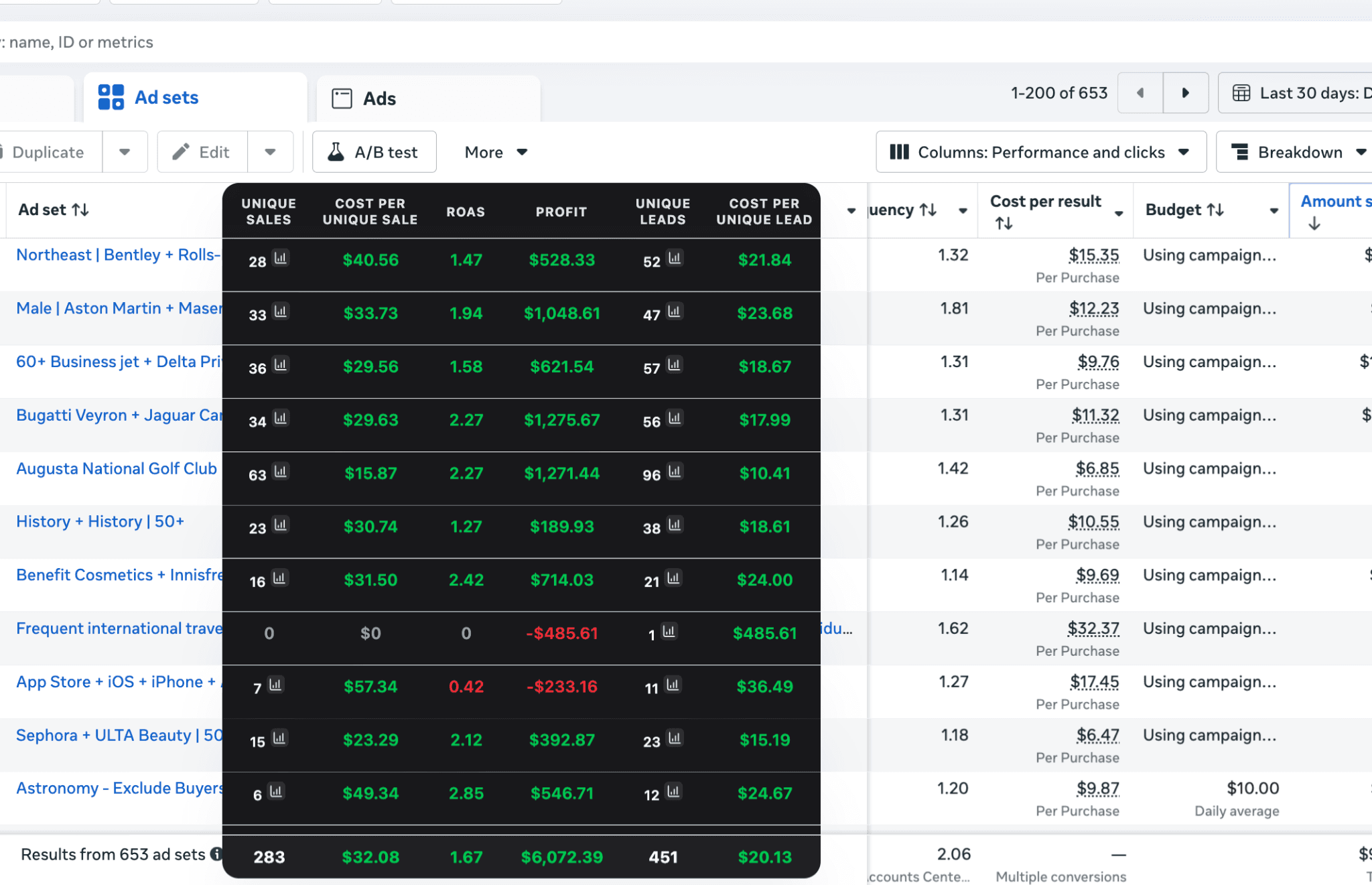
But here’s what makes Roaspy genuinely different: the Chrome extension. You can see your attribution data directly inside your Ads Manager rows without switching tabs. Real-time revenue, lead quality data, actual ROAS per campaign, all visible right where you’re making decisions. When I first saw this working, I was honestly annoyed it hadn’t existed sooner.
Roaspy vs Hyros comes down to this: Hyros gives you deep data in a separate dashboard you have to go visit. Roaspy brings that same depth of data into the platform you’re already working in. That’s not a small difference in practice.
On pricing, Roaspy is significantly more accessible. No gated features based on plan tier. Every plan gets full-funnel tracking, CAPI integrations for Meta and Google, and the Chrome extension. No surprise paywalls when you need advanced attribution. Compared to Hyros at $230 to $1,499+ per month, or AnyTrack at $100 to $300+ per month, Roaspy gives you enterprise-grade server-side tracking for lead generation at a $47/mo (Free up to $1500 ad spend) price.
Here’s the comparison so you can see it clearly:
Feature | Roaspy | Hyros | AnyTrack |
Starting Price | $47/mo (Free up to $1500 ad spend), all features included | ~$230/month, scales to $1,499+ | ~$100/month, scales to $300+ |
Free Trial | Yes | Limited demo | Yes |
Server-Side CAPI (Meta + Google) | Yes, on all plans | Yes | Yes (some plans) |
Attribution Technology | FingerprintJS (Cookieless) | Proprietary pixel + call tracking | Cookie/pixel based |
Ads Manager Chrome Extension | Yes (Unique feature) | No | No |
Full-Funnel Tracking | Yes, all plans | Yes, higher tiers | Partial |
Long-Cycle Lead Attribution | Strong | Strong | Limited |
Setup Complexity | Low | High | Low |
Best For | Agencies, coaches, info products | High-ticket call funnels | Affiliate/volume lead gen |
For the best lead tracking for agencies 2026, Roaspy sits in a category I’d genuinely call its own. It’s not trying to be Hyros. It’s not trying to be AnyTrack. It’s built for the media buyer who needs accuracy and speed without the overhead.
If you want to try it: https://roaspy.com
When comparing Roaspy vs Hyros specifically for lead gen funnels, Roaspy handles server-side tracking for lead generation natively across all plan tiers. No extra configuration. No hidden setup fees. That matters when you’re onboarding a new client and need tracking live within a day.
As a Hyros alternative for lead gen, Roaspy is the most complete option I’ve tested. And I say that as someone who spent years running an agency where tracking accuracy was the difference between scaling a client to $200K a month and wasting their entire budget.
Frequently asked questions
Q: Is AnyTrack or Hyros better for high-ticket coaching funnels specifically?
A: Hyros was built with high-ticket call funnels in mind, so it has a natural edge for coaching businesses that rely on booked calls and long decision cycles. That said, Hyros alternatives for lead gen like Roaspy now offer comparable attribution accuracy at a lower price and with faster setup. If you’re running $5K to $20K offers and need to connect ad spend to closed deals, I’d evaluate Roaspy before committing to Hyros.
Q: How does AnyTrack vs Hyros pricing play out for a small agency with multiple clients?
A: AnyTrack vs Hyros pricing gets painful fast when you’re managing multiple clients. Hyros in particular can cost $230 to $1,499+ per account, which doesn’t scale well across a client roster. AnyTrack is more affordable but has limitations for complex funnels. Roaspy’s transparent pricing model with no gated features is what most small agencies actually need.
Q: What is server-side tracking for lead generation and why does it matter?
A: Server-side tracking for lead generation means your conversion data is sent from a server directly to the ad platform’s API, bypassing browser limitations like ad blockers and iOS privacy restrictions. It’s more accurate than pixel-based tracking, especially for longer attribution windows. In 2026, any serious media buyer should have server-side tracking running as their primary data source.
Q: Does Roaspy work with Google Ads as well as Meta?
A: Yes. Roaspy supports CAPI integrations for both Meta and Google Ads, so you’re covered across both major platforms. That’s one reason why Roaspy vs Hyros comparisons favor Roaspy for agencies running multi-platform campaigns. Hyros is primarily built around Meta and call tracking, whereas Roaspy handles both ad channels natively.
Q: What makes Roaspy a legitimate Hyros alternative for lead gen?
A: FingerprintJS technology is the core reason. It gives Roaspy the ability to track users across sessions without cookie dependency, which is what Hyros achieves with its proprietary system. Add in the Chrome extension for in-Ads-Manager visibility and fully ungated features on every plan, and Roaspy vs Hyros becomes a genuine choice rather than a compromise. You’re not sacrificing accuracy, you’re just paying less and working faster.
Q: Is the best lead tracking for agencies in 2026 really about the tool or the setup?
A: Both. You can have the best tool on the market and still get garbage data if your funnel events aren’t firing correctly, your CRM webhooks are misconfigured, or your attribution windows don’t match your actual sales cycle. The best lead tracking for agencies 2026 requires the right tool AND a clean implementation. Roaspy’s setup is simple enough that most agencies are live within hours, not weeks.
My final thoughts
I’ve been in this industry long enough to remember when “tracking” meant checking your Facebook Ads dashboard and trusting whatever number it showed you. Those days are gone. In 2026, the media buyers winning are the ones who have accurate, complete attribution data and can act on it quickly. Not in a separate dashboard. Not after a 30-minute analysis session. Right where they’re working.
The AnyTrack vs Hyros lead generation debate is real and worth having. AnyTrack is a solid tool for the right use case. Hyros is genuinely powerful for high-ticket call funnels. But both leave you with the same problem: you have to leave your workflow to access the truth about your campaigns. That slowdown compounds over time, especially for agencies managing multiple ad accounts.
What I kept coming back to was that the best lead tracking for agencies in 2026 needs to meet you where you are. The data should live in your Ads Manager, not three tabs over. And it shouldn’t cost you a premium just to access the features that should have been standard from the start.
Roaspy vs Hyros isn’t a close call for me anymore. Roaspy gives me FingerprintJS accuracy, server-side tracking for lead generation built into every plan, CAPI for both Meta and Google, and the Chrome extension that shows me real-time attribution inside Ads Manager rows. At a price that actually makes sense for agencies. I’m not pitching this as a perfect product because no tool is. But it’s the one I actually use, and it’s the one I recommend to the operators I work with.
If you’re still jumping between dashboards trying to piece together which ad actually drove your last ten sales, go try Roaspy: https://roaspy.com
Stop flying blind. Your budget deserves better data than that.