Introduction
If you’re running paid media in 2026 and you’re still using ClickMagick as your primary attribution tool, I’d argue you’re flying partially blind. As a ClickMagick alternative for media buyers, Roaspy isn’t just a cheaper option or a rebrand of the same idea. It’s a fundamentally different approach to tracking one built for the server-side, cookieless, AI-driven world we’re actually living in right now, not the pixel-and-redirect world of five years ago.
In this post, I’m going to break down exactly where ClickMagick falls short for modern media buying operations, why signal quality and workflow efficiency are the two metrics that matter most in 2026, and how Roaspy addresses both in ways legacy tools simply can’t. I’ll get into the technical side, the workflow side, and the pricing reality. By the end, you’ll have a clear picture of whether switching makes sense for you.
The link-first problem: why ClickMagick’s architecture is showing its age
ClickMagick was built in an era where tracking links were the solution to everything. You wrap a link, add a pixel, and watch the clicks roll in. That model made a lot of sense in 2015. In 2026, it’s a handicap.
The core issue with a link-first approach is the redirect. Every click through a ClickMagick tracking link passes through their servers before hitting your destination. That adds latency. Small amounts, sure, but it also introduces a point of failure, a cookie dependency, and a visible URL structure that savvy ad reviewers and browsers increasingly flag or strip.
Honestly, the redirect model always bothered me, even back in my agency days. We were spending serious money on traffic and then routing it through a middleman before it even hit the landing page. That’s friction you just don’t need.
When you think about what makes the best ad tracking for agencies in 2026, it shouldn’t be creating more steps between your ad and your conversion. It should be invisible infrastructure that captures everything without touching the user’s journey. The Roaspy vs ClickMagick for media buying debate really starts here, at the architectural level. One tool wraps your links. The other sits underneath your entire funnel without your audience ever knowing it’s there.
The redirect-based model also struggles with attribution in longer funnels. If someone clicks your ad, visits the page, leaves, comes back three days later via organic search, and then buys, ClickMagick’s link tracking misses that reconnection. It’s session-dependent in ways that modern server-side tracking isn’t.
Signal quality is everything in 2026: what the AI optimization engines actually need
Meta’s algorithm doesn’t care about your spreadsheets. It cares about the signals you send it.
This is the thing most people underestimate when they’re shopping for Meta ads attribution software 2026. They focus on the reporting dashboard. They look at the charts and the ROAS numbers and think, “Okay, this tells me what worked.” But the real power of modern tracking isn’t the reporting. It’s the Conversion API integration that fires clean, matched, verified events back to Meta’s servers so the algorithm knows who converted and can find more of them.
When your server-side tracking for Facebook ads is weak, you’re not just missing data. You’re actively starving the optimization engine. Meta’s AI needs high-quality, low-latency event signals to do its job. If you’re relying on browser pixels alone, you’re losing a significant portion of tracked conversions due to browser restrictions, depending on traffic. That’s not a reporting problem. That’s a campaign performance problem.
I covered something related to this in a recent video (Our Ads Tracking Is 100% Accurate (This Is How We Did It))about accurate tracking for scaling, and the core message was this: the tool that best feeds the algorithm wins, full stop. When I think about what separates good Meta ads attribution software 2026 from great, it’s CAPI implementation quality. Not dashboards. Not pretty charts. The signal.
Roaspy’s CAPI integration is built to send back matched, verified events with FingerprintJS-based identifiers. That means even when cookies are blocked, even when the pixel fires late or gets rejected, the server-to-server handshake still happens. The algorithm still gets the signal. Your campaigns still optimizing. This is the practical reason server-side tracking for Facebook ads matters beyond just “better data accuracy.” It directly affects your CPL and ROAS at scale.
The tab problem: why media buyers need data where decisions get made
Here’s something nobody really talks about in the Roaspy vs ClickMagick for media buying conversation. The workflow problem.
When you’re managing campaigns for multiple clients, or running a high-volume internal media buying operation, your Ads Manager is your cockpit. You live there. You’re reviewing CPMs, CTRs, cost per purchase, and frequency. Every decision happens in that interface. So why would you want to jump to a separate analytics dashboard every time you need to check attribution data?
I’ve been there. You’re in Ads Manager at 7 AM trying to decide which ad sets to kill before the daily budget resets. You’ve got 30 ad sets running. You’d need to open a separate tab, log into your tracker, filter by the right date range, find the matching campaign, cross-reference the ad set name (which your tracker may or may not have synced correctly), and then come back to Ads Manager to take action. By the time you’ve done that five times, you’ve lost 45 minutes and probably made a few gut-feel decisions you shouldn’t have.
This is why the best ad tracking for agencies in 2026 has to live inside the workflow, not alongside it.
Roaspy’s Chrome extension solves this in a way that genuinely impressed me when I first tried it. It injects verified attribution data directly into your Ads Manager rows. Right there next to Meta’s native data, you see your actual tracked revenue, ROAS, and cost per conversion from Roaspy’s attribution. No tab switching. No cross-referencing. You see a losing ad set, you turn it off. You see a winner, you scale it. All in one screen.
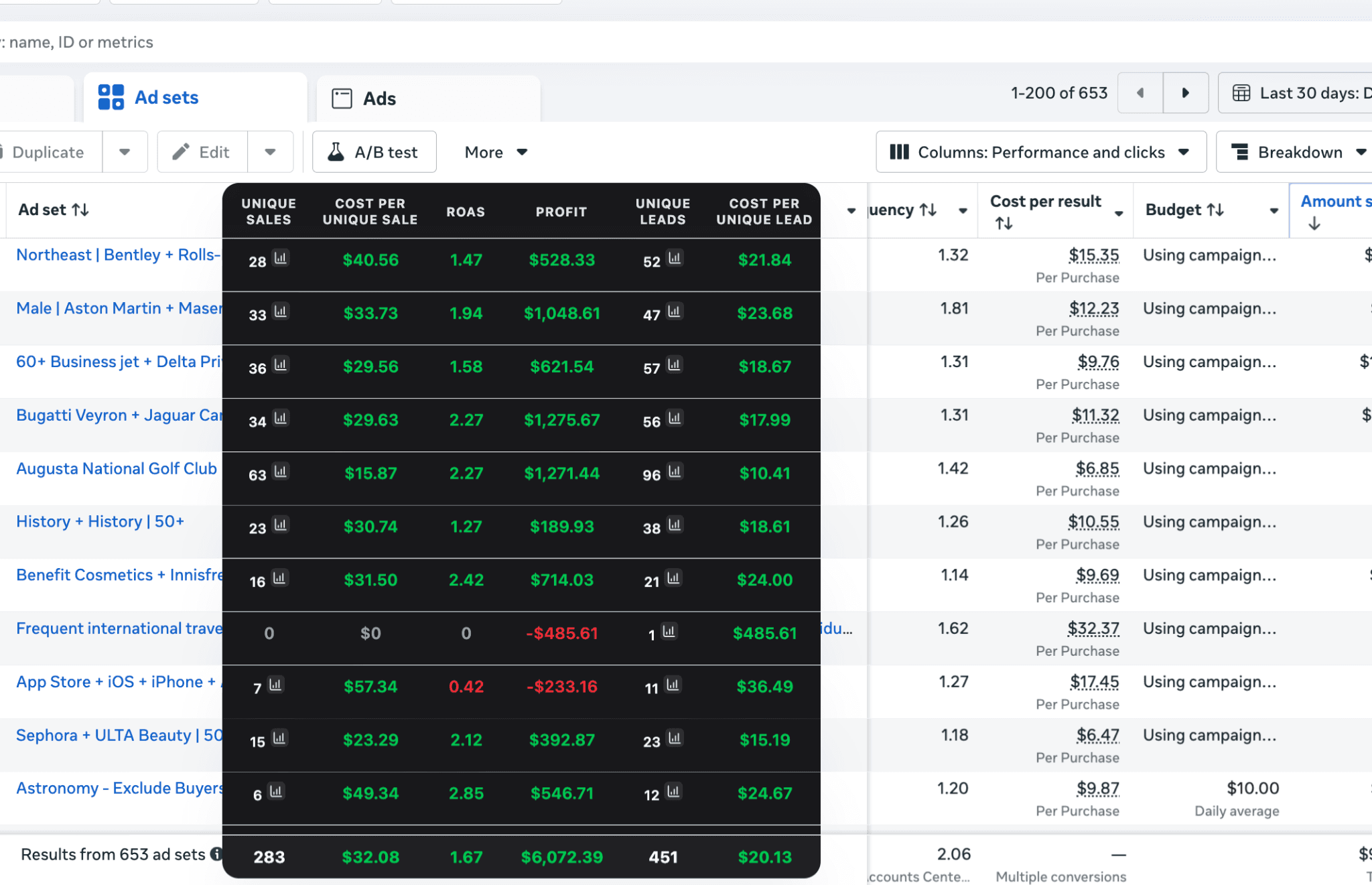
For anyone evaluating Meta ads attribution software 2026, this alone is a significant workflow upgrade over what ClickMagick offers.
FingerprintJS vs redirect tracking: the technical gap that matters most
Let me get a little technical here because I think this matters more than most people realize.
ClickMagick tracks through URL parameters and cookies set during the redirect. That means tracking depends on the click ID surviving the redirect, the cookie being accepted by the browser, and the same browser being used at conversion. In 2026, that’s three pretty fragile assumptions.
Roaspy uses FingerprintJS technology to generate a persistent, unique visitor identifier without relying on cookies. FingerprintJS analyzes hundreds of browser and device signals (screen resolution, installed fonts, GPU info, browser configuration) to create a stable fingerprint that persists across sessions. It’s cookieless. It works across ad blockers. It doesn’t require a redirect. And it’s invisible to the end user while being crystal clear to you as the buyer.
From a technical standpoint, this is a genuinely different class of tracking. When I first started digging into server-side tracking for Facebook ads seriously, I kept running into the same limitation with redirect-based tools: they could tell me what happened at the click, but they lost the thread when the user came back later, switched browsers, or cleared cookies. FingerprintJS doesn’t lose that thread.
The result is higher match rates on your CAPI events. Meta wants a match rate above 7.0 on your event match quality score. With cookie-dependent tracking, a lot of agencies are scraping by at 5–6. With Roaspy’s fingerprint-based identification feeding into CAPI, you’re pushing into that 7–8+ range. That directly affects how well the AI can optimize.
This is really the heart of the Roaspy vs ClickMagick for media buying comparison from a technical standpoint. It’s not about features on a checklist. It’s about the fundamental tracking mechanism and whether it holds up in real-world conditions.
Pricing reality check: what you actually pay and what you actually get
Let me be straight with you about pricing because this is where a lot of comparisons get dishonest.
ClickMagick’s entry plan starts at $79/month. At that tier, you get basic tracking, limited funnels, and a fairly restricted feature set. To get the full feature set, you’re looking at $199/month or more. HYROS, which many agencies use as a more advanced alternative, starts at around $230/month and scales based on revenue. Segmetrics and similar tools sit in the $100–$300/month range, depending on plan.
Roaspy’s pricing is transparent $47/mo(free up to $1500 ad spend). No gated features. Every plan includes full-funnel tracking, the Chrome extension, CAPI integrations for both Meta and Google Ads, and the FingerprintJS-based attribution. You’re not paying extra to unlock server-side tracking. You’re not upgrading to access the Ads Manager extension. It’s all there from the start.
When I was running my agency, one of my biggest frustrations was tools that charged premium prices for features that should have been standard. At $349/month for ClickMagick’s full tier, you’re still working with redirect-based tracking and no native Chrome extension for Ads Manager. That’s a real gap when you’re comparing it to what Roaspy offers.
Here’s a direct comparison that I think helps clarify the decision:
Feature | Roaspy | ClickMagick |
Tracking Method | FingerprintJS (cookieless) | Redirect + cookie-based |
CAPI Integration (Meta) | Yes, on all plans | Limited / manual setup |
CAPI Integration (Google Ads) | Yes, on all plans | Limited |
Chrome Extension for Ads Manager | Yes | No |
Full-Funnel Attribution | Yes, all plans | Higher tiers only |
Pricing (Entry Level) | $47/mo (Free up to $1,500 ad spend) | $79/month (Features gated) |
Gated Features | No | Yes |
Tech Stack | Modern (React, JS) | Legacy |
Best For | Media Buyers, Agencies, Coaches | Individual Affiliates, Basic Link Tracking |
This comparison makes it pretty clear why Roaspy has become the preferred ClickMagick alternative for media buyers who are running serious ad budgets.
Why I recommend Roaspy as the best ad tracking for agencies in 2026
I want to be direct here. I built Roaspy because I couldn’t find a tool that did what I needed it to do at a price that made sense for the agencies and coaches I work with.
When I was managing over $10M in ad spend across my agency’s client portfolio, I bounced between tools constantly. We used HYROS for a while. We tried ClickMagick. We went through a phase with AnyTrack. Every tool had something that drove me crazy, whether it was the price jump for server-side features, the redirect latency, the dashboard that lived three clicks away from where I actually made decisions, or the gated attribution data that required an enterprise upgrade.
Roaspy was built to fix those specific frustrations. The Chrome extension that injects data directly into Ads Manager rows was the feature I personally wanted most. The FingerprintJS-based tracking was the technical requirement I knew we needed to survive the cookieless shift. The transparent, ungated pricing was the business decision I made because I was tired of tools that nickel-and-dimed agencies for features that should have been standard.
When it comes to Meta ads attribution software 2026, Roaspy stands apart because it’s built on a modern React and JavaScript stack, it uses cutting-edge fingerprinting technology instead of redirects, and it’s designed for how media buyers actually work, not how tracking tools used to work.
For anyone evaluating the best ad tracking for agencies right now, here’s my honest take: if you’re running more than $5K/month in paid social or Google Ads, and you’re making optimization decisions inside Ads Manager, you need something that integrates with that workflow. You need server-side tracking for Facebook ads that doesn’t require you to manage a parallel tab. You need CAPI events that are matched and verified, not just fired and forgotten.
That’s what Roaspy does. And that’s why I use it.
Try it at https://roaspy.com. No feature gates. No upgrade wall.
Frequently asked questions
Q: Is Roaspy really a better ClickMagick alternative for media buyers, or is it just cheaper?
A: It’s genuinely different at a technical level, not just cheaper. The tracking mechanism is fundamentally different. FingerprintJS-based cookieless tracking versus redirect-based cookie tracking is a real architectural gap, and in 2026 that gap shows up in your event match quality scores and your CAPI performance. The Chrome extension for Ads Manager is also something ClickMagick simply doesn’t have, which matters a lot for workflow efficiency at scale.
Q: How does Roaspy’s CAPI integration compare to what ClickMagick offers for Meta ads?
A: ClickMagick does offer server-side event support, but it requires more manual configuration and relies on the click ID surviving the redirect chain. Roaspy’s CAPI integration uses FingerprintJS-identified visitors to send matched, verified events with higher accuracy. That higher event match quality directly influences how well Meta’s algorithm can optimize your campaigns. For anyone focused on Meta ads attribution software 2026, that’s a meaningful difference.
Q: Does Roaspy work for Google Ads as well, or is it just for Meta?
A: Roaspy supports CAPI-style server-side tracking for both Meta and Google Ads on all plans. So if you’re running a blended paid media strategy across both platforms, you don’t need two different tools or two different setups. It’s all in one place and it’s not locked behind an enterprise tier.
Q: What kind of agencies or media buyers is Roaspy best suited for?
A: From my experience, Roaspy fits best for agencies managing Facebook and Google Ads for coaching businesses, info-product creators, and high-ticket offers. It’s also excellent for in-house media buyers at DTC brands who need accurate attribution without paying HYROS-level prices. If you’re running above $5K/month in ad spend and optimization decisions matter to you, it’s worth evaluating.
Q: If I switch from ClickMagick to Roaspy, how disruptive is the migration?
A: Less disruptive than you’d expect. Because Roaspy doesn’t rely on link wrapping the way ClickMagick does, you don’t need to replace every tracking link in every campaign. The setup involves adding a script to your funnel pages and configuring your CAPI connection, which most people complete in a few hours. The Chrome extension installs in about 60 seconds. I’d say it’s a lighter lift than migrating between most SaaS tools.
Q: Is server-side tracking for Facebook ads actually necessary, or is it just a nice-to-have?
A: In 2026, I’d call it necessary. iOS privacy changes, browser restrictions on third-party cookies, and the increasing rate of ad blockers mean browser-pixel-only tracking is routinely missing 20–40% of your conversions. Server-side tracking for Facebook ads fills that gap by sending events directly from your server to Meta, bypassing the browser entirely. Missing that data doesn’t just mean bad reports; it means your campaign optimization is working with incomplete information.
My final thoughts
Here’s what I want to leave you with. The tracking tool conversation in digital marketing has shifted dramatically over the last two years. It used to be about who had the prettiest dashboard or the most integrations. Now it’s about who can deliver the cleanest signal to the ad platforms so the AI has what it needs to work properly.
ClickMagick served a real purpose for a long time, and I’m not dismissing it entirely. But its link-first, redirect-based architecture was designed for a world where cookies were universal and browser tracking was reliable. That world is gone. If you’re still using it as your primary attribution layer for serious ad spend, you’re making optimization decisions on incomplete data, and you’re probably not getting the CAPI event quality you need to let Meta’s algorithm do its best work.
The ClickMagick alternative for media buyers that actually solves this problem in 2026 isn’t just a tool with better reporting. It’s a tool with better infrastructure. FingerprintJS-based tracking, native CAPI integration for both Meta and Google, and a Chrome extension that puts verified ROI data right inside Ads Manager. That combination is what I built Roaspy to deliver, and it’s what I personally use to make media buying decisions every day.
If you’re ready to see what accurate, server-side, workflow-friendly tracking actually looks like in practice, go check out https://roaspy.com. No feature gates. No redirect bloat. Just clean data where you need it.