Introduction
Let me give you the direct answer first: Hyros’ cost in 2026 is still steep for most small agencies, and for the majority of boutique shops managing under $500K/month in client ad spend, the pricing model creates more financial pressure than it solves tracking problems. If you’re running a lean operation, managing a handful of high-ticket coaching or info-product clients, and trying to protect your margins, Hyros pricing for small agencies has become genuinely hard to justify without a serious ROI conversation.
What I’m going to walk you through here is a real consultative audit of Hyros cost 2026, the hidden fees most people don’t talk about, and what the alternatives actually look like for a small agency trying to deliver elite-level attribution without paying enterprise prices. I’ll also show you exactly why high-ticket attribution pricing doesn’t have to mean locking yourself into a revenue-based contract with mandatory sales demos. By the end, you’ll have a clear picture of what your options are and what I’d actually do if I were running a small agency today.
What Hyros actually costs in 2026 (the full picture)
Here’s what most blog posts won’t tell you upfront: Hyros doesn’t publish a pricing page. You have to book a demo, sit through a sales call, and then get a quote based on your clients’ revenue. That alone should tell you something about who this tool was built for.
From everything I’ve gathered, talking to agency owners and media buyers across the industry, Hyros cost in 2026 typically starts around $300–$500/month at the entry level for smaller accounts, but that number climbs fast. Once you’re tracking clients doing meaningful revenue, you’re often looking at $800, $1,200, even $2,000+ per month, depending on the tier and the contract terms they lock you into.
I’ll be honest: the first time I looked at Hyros pricing for small agencies seriously, I thought the per-client cost structure would make sense if I could pass it through to clients. But that math only works if your clients are paying you enough margin to absorb it. Most small agencies I know aren’t there.
The revenue-based pricing model is the real issue. Hyros scales their fees based on what your clients earn, not what you spend on ads. So the better your campaigns perform, the more Hyros charges you. That’s a punishing incentive structure for anyone whose entire value proposition is growing client revenue.
High-ticket attribution pricing at this level isn’t inherently wrong. These are genuinely powerful tools. But the cost structure assumes you’re operating at a scale that most boutique agencies simply haven’t reached yet.
The hidden costs that kill small agency margins
Beyond the base subscription, there are layers to Hyros’ cost in 2026 that catch people off guard.
First, there’s the onboarding and setup investment. Getting Hyros properly configured, especially for complex funnels with webinar sequences and multi-step email follow-ups, takes real time. That’s either your time or a contractor’s. Neither is free.
Second, you’re almost always looking at annual contracts. Hyros doesn’t do month-to-month for most of their tiers. So if a client churns three months in, you’re eating the remaining contract cost. I’ve talked to agency owners who’ve been burned by exactly this scenario, and it’s painful.
Third, the per-seat or per-account limits on some tiers create a ceiling that forces upgrades faster than you expect. Ad tracking for small agencies needs to be flexible. When you add a new client, you shouldn’t have to call your tracking tool’s sales team to negotiate a plan change.
Nobody really talks about the cumulative cost of these decisions. You’re not just paying $500/month. You’re paying $500/month plus setup time plus contract lock-in risk plus potential upgrade fees. When you model that out across a year, Hyros’ pricing for small agencies starts looking a lot less competitive than the headline number suggests.
If you’re evaluating Hyros alternatives for agencies, the total cost of ownership has to be part of that conversation, not just the monthly fee.
Hyros pricing for small agencies: the revenue-scaling trap
This is the part I see people get wrong the most. They evaluate ad tracking for small agencies purely on monthly cost, not on how that cost changes as their clients scale.
Hyros ties pricing to client revenue. In theory, this sounds fair. You pay more as your clients earn more. But in practice, it creates a dangerous ceiling for agency profitability. Here’s why.
When your client’s revenue grows, your Hyros bill grows with it. But your retainer from that client might not grow at the same pace. Unless you’ve built revenue-share agreements into every contract (which most small agencies haven’t), you absorb the cost increase while your client captures the upside.
I’ve seen this squeeze margins in real time. An agency owner I know went from paying around $400/month for Hyros to over $1,100/month within eight months because two of her clients had strong Q4 results. Her retainers didn’t move. Her Hyros cost nearly triple in 2026.
That’s the trap.
High-ticket attribution pricing should scale with your business model, not against it. If you’re running webinar funnels or evergreen course launches for coaches, you need attribution that covers 30, 60, or even 90-day windows because that’s how those funnels actually convert. You need email-to-sale mapping. You need multi-touch visibility. But you shouldn’t have to surrender your margins to get it.
When I’m looking at Hyros alternatives for agencies, the pricing structure is honestly the first filter. Not features. Not integrations. The structure.
Ad tracking for small agencies: what you actually need vs. what Hyros sells you
Let me cut through some noise here. Hyros is a genuinely good product. I’m not going to pretend otherwise. The email-to-sale tracking, the AI attribution layer, the cross-device visibility — it’s impressive. For large media buying shops running $1M+ per month across a portfolio of clients, the Hyros cost 2026 probably makes complete sense.
But most small agencies don’t need everything in that stack.
Ad tracking for small agencies typically comes down to a few non-negotiables: accurate source attribution, long-window tracking (because high-ticket sales cycles are long), email click-to-conversion mapping, and clean data you can actually show to clients. That’s it. You don’t need the most sophisticated AI attribution engine ever built. You need reliable data that helps you make better media buying decisions and justify your retainer.
The problem with Hyros pricing for small agencies is that you’re paying for a feature set designed for enterprise-scale operations. You’re paying for complexity you might use 30% of.
And here’s something nobody in the Hyros sales process will tell you: most of the core attribution capabilities you actually need for high-ticket info products and webinar funnels are now available at a fraction of the price through purpose-built alternatives. High-ticket attribution pricing has come down significantly as the market has matured. What cost $1,000/month two years ago costs $150/month today with the right tool.
The mandatory demo model that Hyros uses isn’t just annoying. It signals that pricing is negotiable and opaque, which means two agencies paying for similar tracking may be on wildly different contracts. That’s not a system built in your favor.
The best Hyros alternatives for agencies in 2026
So if not Hyros, what? I’ve tested or closely evaluated most of the serious contenders in this space. Here’s how I recommend the field for ad tracking for small agencies.
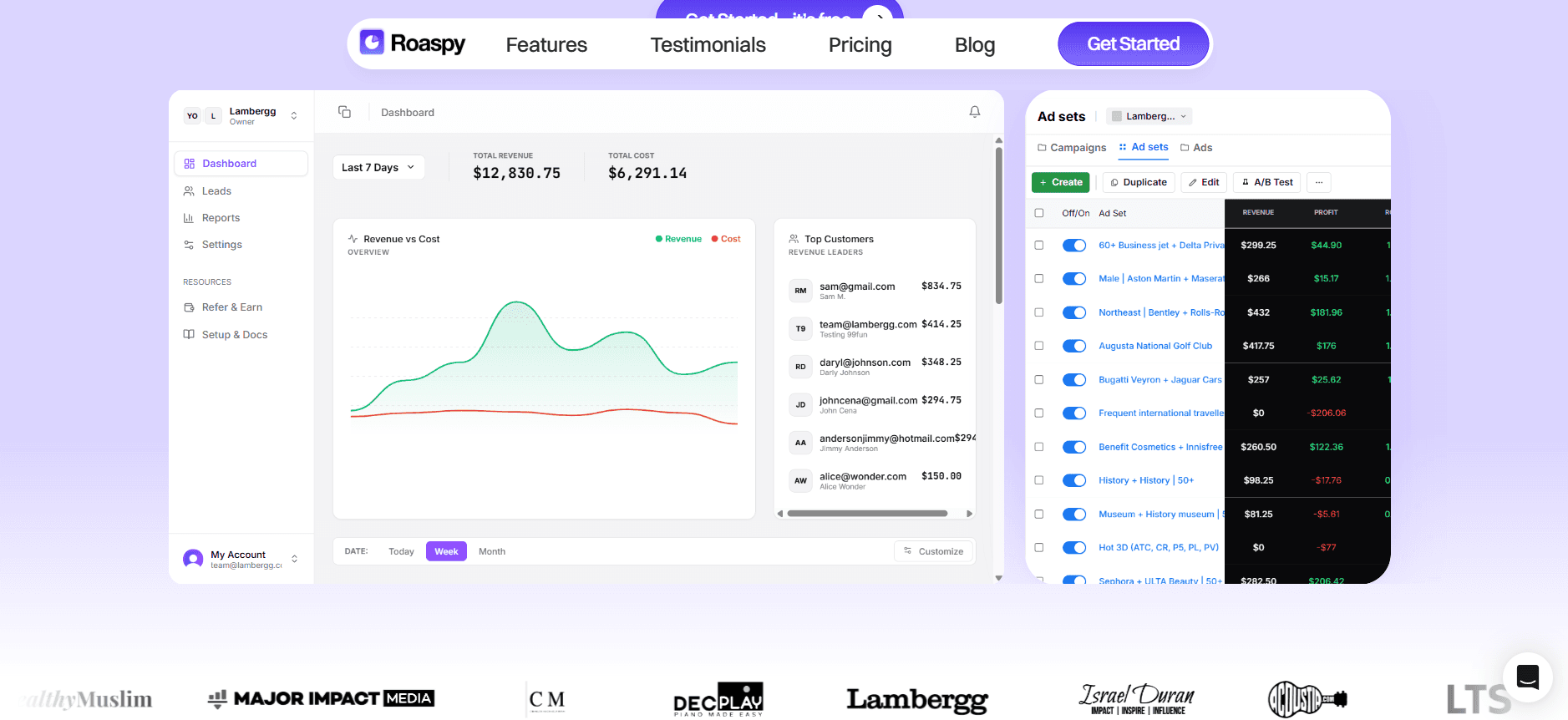
Among the growing list of Hyros alternatives in 2026, Roaspy stands out as a practical option for advertisers who want accurate tracking without the high cost and complexity of enterprise attribution tools. Roaspy focuses on solving the core problem most advertisers face after iOS 14: recovering lost conversions and sending accurate data back to Meta through server-side CAPI tracking.
The platform is designed to be simple and fast to set up, with most users able to get tracking running in under 30 minutes. Roaspy also integrates directly with Meta Ads Manager, allowing advertisers to see clearer attribution data when optimizing campaigns.
Pricing is significantly more accessible as well. Roaspy offers a free plan for up to $1,500 in ad spend per month, with paid plans starting at $47 per month. This makes it a far more practical option for many small businesses and growing advertisers who need reliable ad tracking without committing to expensive enterprise tools.
The pattern across many Facebook ads attribution tools is simple: the more complex the platform, the more expensive it becomes, and the less likely most advertisers are to actually use everything they’re paying for. The better approach is choosing a tool that fits your real needs rather than one with the longest feature list.
Why I recommend Roaspy for small agencies
This is where I’ll just be straight with you. I use Roaspy. Not because I helped build it or because I’m obligated to mention it. Because after years of paying for tools that either over-delivered on complexity I didn’t need or under-delivered on the attribution depth I did need, Roaspy solved a specific problem I kept running into.
The problem was this: I needed 30-plus-day attribution windows for clients running webinar and VSL funnels. I needed email click tracking tied back to actual ad sources. And I needed to show clients clean, readable attribution data without wrapping myself in a $1,000/month contract that scaled against me when their results improved.
Roaspy is built specifically for high-ticket info products, digital courses, and webinar funnels. It does the things that actually matter for this niche: long-window attribution, email-to-sale mapping, transparent source tracking, and clean reporting you can put in front of a client without a 20-minute explanation.
The pricing is public. No demo required. No revenue-based scaling that punishes you for growing your clients’ businesses. That transparency alone separates it from the Hyros model.
Here’s a quick comparison of what matters for agencies like mine:
Feature | Hyros (Enterprise Focus) | Roaspy (Agency/Info-Product Focus) |
Pricing Model | Revenue-Based Scaling: Costs increase as your client’s revenue grows. | Transparent: Fixed tiers that don’t punish your growth. |
Cost (Estimated 2026) | $300 – $2,000+ per month (Opaque). | Free starting tier; Paid plans from $47/month. |
Sales Process | Mandatory Demo & Sales Call. | Public pricing; Self-serve signup. |
Contract Terms | Typically Annual (High churn risk). | Flexible / Month-to-Month. |
Setup Time | Days to Weeks (Guided onboarding). | Under 30 Minutes (Self-serve). |
Attribution Window | 30, 60, 90+ Days. | 30+ Day Multi-Touch (Standard). |
Key Specialization | Enterprise-scale AI & broad data sets. | High-Ticket Funnels, Webinars, & VSLs. |
Server-Side CAPI | Included (Complex configuration). | Included (Simplified direct integration). |
Email-to-Sale Mapping | Yes. | Yes. |
UI/UX Aesthetic | Complex / Data-heavy. | Clean, High-End SaaS Aesthetic. |
The moment I stopped wrestling with Hyros’ pricing for small agencies and switched to a tool built for my actual use case, my cost-per-client for attribution dropped significantly. And my clients got better data, not worse.
If you’re running ad tracking for small agencies and want to see what this looks like without sitting through a sales demo, go check it out at https://roaspy.com/.
Frequently asked questions
Q: Is Hyros still worth it for a small agency in 2026?
A: For most small agencies, honestly, no. The revenue-based pricing and annual contract structure make Hyros cost 2026 hard to justify unless you’re managing very high ad spend or have retainers that absorb the variable cost. If you’re running lean, there are better-fit options for ad tracking for small agencies at a fraction of the price.
Q: Does Hyros publish its pricing anywhere?
A: No. Hyros requires a demo call to get pricing, which means costs vary between agencies and are largely negotiated. This opacity is one of the biggest complaints I hear from people exploring Hyros alternatives for agencies — you can’t even compare properly without going through their sales process.
Q: What’s the main difference between Hyros and Roaspy for high-ticket funnels?
A: Both tools offer email-to-sale tracking and long-window attribution, which is what matters most for high-ticket info products and webinar funnels. The core difference is that Roaspy offers transparent, flat pricing built specifically for this niche, while Hyros is a broader enterprise tool with pricing that scales based on client revenue. For smaller agencies, that distinction has a direct impact on margin.
Q: How much does Hyros typically cost per month for a small agency in 2026?
A: Based on what agency owners consistently report, Hyros cost 2026 starts somewhere in the $300–$500/month range for entry-level accounts, but most agencies managing multiple clients with real revenue end up in the $800–$2,000/month range. And because it’s revenue-based, that number moves as your clients scale.
Q: What should I look for in a Hyros alternative for my agency?
A: Three things. First, transparent pricing you can model before you commit. Second, long-window attribution (30 days minimum, 60–90 days ideally) because high-ticket attribution pricing needs to reflect real sales cycles. Third, email click-to-conversion mapping because that’s where most attribution breaks down for info product and coaching funnels. Those three filters will narrow your list fast.
Q: Can I switch from Hyros to another tool without losing historical data?
A: It depends on the tool you’re moving to and how your tracking is set up, but in most cases, you can export historical data from Hyros in CSV format and import it into a new platform. The transition period does require running both systems briefly to validate accuracy. It’s a bit of work upfront, but agencies I’ve spoken to who made the switch say it paid off within the first two months on the new tool.
My final thoughts
I’ve been in this industry long enough to remember when any attribution data felt like a luxury. We were making million-dollar ad spend decisions based on last-click tracking and gut instinct. The fact that tools like Hyros exist, and that the high-ticket attribution pricing conversation is even happening at the small agency level, is genuinely a sign of how far the field has come.
But Hyros built its product and its pricing model for a specific customer. That customer is a well-funded media buying operation or an in-house team at a company doing serious eight-figure revenue. If that’s you, Hyros cost 2026 probably makes sense in the context of what you’re managing.
If you’re a smaller shop, maybe a two- to five-person agency, working with coaching businesses, course creators, and webinar-driven offers, you’ve been trying to force yourself into a tool that was never designed for your scale. That’s not a failure on your part. It’s a pricing mismatch. And the market finally has better answers for ad tracking for small agencies than it did even two years ago.
What I’d tell a friend starting or growing a boutique agency today: stop assuming the most expensive tool is the most accurate tool. In high-ticket attribution pricing, the gap between enterprise and purpose-built solutions has narrowed dramatically. The agencies I see winning right now are the ones running lean, purpose-built stacks, not the ones paying $1,500/month for tracking features they’re using a fraction of.
Hyros pricing for small agencies is simply not designed with your margin structure in mind. That’s the honest summary.
If you want to see what tracking looks like when it’s built for the actual funnel type you’re running, go take a look at Roaspy. No demo required. No sales call. Just transparent pricing and a tool built for the exact category of offers you’re most likely running. Start there: https://roaspy.com/.