Introduction
If you’re trying to choose the right 2026 webinar attribution tool and you’re stuck between these two giants, here’s my honest take: Hyros wins on call tracking and long-cycle funnels, Wicked Reports wins on LTV and subscription businesses, and neither one is a clean winner for the modern high-ticket webinar operator who wants accuracy without paying a revenue tax or spending three weeks on setup. The debate around Hyros vs Wicked Reports for webinars has been going on for years, and in 2026, the answer is more nuanced than most comparison posts admit.
In this post, I’m going to walk through what each platform actually does well, where each one falls short specifically for webinar funnels, and why I eventually moved away from both. I’ll cover pricing, setup reality, iOS 14+ recovery, 30-day journey mapping, and the specific moments where each tool either earns its cost or doesn’t. By the end, you’ll have a clear picture of which tool fits which type of business, and you’ll know what I use now to track webinar ROI for the accounts I manage.
What Hyros actually does for webinar funnels
Hyros built its reputation on one thing: following a lead through a complicated, multi-touchpoint journey and still connecting the final sale back to the original ad click. For high-ticket funnels that involve a webinar, a follow-up email sequence, a sales call, and sometimes a 30-day nurture, that capability matters enormously.
The platform uses AI-assisted tracking combined with first-party data ingestion. It pulls email addresses from opt-in forms, matches them across touchpoints, and tracks phone sales through a tagging system that ties back to your ad spend. If you’re running a coaching offer at $3,000+ with a consultative sales process, this architecture makes sense.
I’ll be honest, when I first saw a Hyros demo, I was genuinely impressed, but that impression fades the moment you see the implementation bill. The depth of funnel visibility was unlike anything I’d used at that point.
The webinar registration tracking specifically works through pixel events and email matching. When someone registers for your webinar, Hyros captures that email, then tracks what happens downstream, whether they show up, whether they book a call, or whether they buy. That full-funnel thread is genuinely useful if your sales cycle runs longer than a week.
Where it gets complicated is the setup. Hyros requires custom script installation, CRM integration, and often a dedicated onboarding call just to get things firing correctly. For a solopreneur running their first high-ticket webinar, that’s friction. For an agency managing 10 accounts, it’s multiplied friction. The platform is powerful, but it’s designed for businesses that have technical resources or are willing to hire them.
Pricing sits at roughly $299/month on the lower end, scaling up based on ad spend. Once you start pushing real volume, you can find yourself in the $500 to $800+ range monthly. That’s not outrageous if the data is clean. But if setup issues cause tracking gaps, you’re paying a lot for incomplete information.
Hyros webinar tracking review: the good, the bad, and the expensive
Let me give you my actual Hyros webinar tracking review based on working with it across several info product accounts.
The good: Call tracking is legitimately excellent. If your funnel involves a human closing the sale on a phone call after a webinar, Hyros handles that better than almost anything else I’ve tested. The ability to tie a phone sale back to a Facebook ad from three weeks ago is real, and it works. The reporting interface, once you understand it, surfaces data that Facebook Ads Manager simply cannot show you.
The bad: Email matching isn’t perfect. If a lead uses different email addresses at different stages, the chain breaks. I’ve seen attribution gaps that created false negatives on campaigns that were actually performing. You’d look at the data and want to kill an ad set that was actually your best performer.
The expensive truth is this: Hyros charges based on ad spend in some tiers, which means your cost goes up as you scale, even if the tool isn’t adding proportionally more value. That revenue-correlated pricing model frustrates me. You’re being penalized for growing.
For a full Hyros webinar tracking review, you also have to mention the iOS 14+ recovery. Hyros does offer CAPI integration, and it works. But configuring it correctly requires technical knowledge that a lot of course creators and webinar operators simply don’t have. Support is available, but it’s not instant.
The bottom line on Hyros: it’s the right tool if you have the budget, the technical capacity, and a high-ticket offer with a phone sales component. If any one of those three conditions is missing, it’s probably overkill.
Wicked Reports for info products: where it shines and where it struggles
Wicked Reports for info products has a very different origin story. It was built with the email marketer in mind, specifically the kind of business that sends long nurture sequences, has recurring revenue, and wants to understand lifetime value at the cohort level.
If you’re selling a membership, a continuity program, or a course with payment plans and upsells, Wicked Reports for info products genuinely earns its keep. The LTV attribution is strong. The cohort analysis tells you which campaigns brought in customers who actually stuck around and paid over time versus customers who churned after month one.
A client I worked with last year had a webinar funnel feeding into a $197/month membership. Wicked Reports was showing us that one specific Facebook campaign was generating members with a 9-month average retention while another campaign’s members churned at month 3. That kind of insight changes how you allocate budget. You stop optimizing for conversion cost and start optimizing for retained revenue. That’s where Wicked Reports shines brightest.
Where it struggles specifically for webinars: the 30-day attribution window behavior can be inconsistent across different configurations, and the webinar registration event tracking isn’t as tightly integrated as you’d want. You can make it work, but it takes custom event setup and some tolerance for ambiguity in the data.
Pricing for Wicked Reports starts around $250/month and also scales, though less aggressively than Hyros in my experience. Still, it’s not cheap, and if you’re not running significant recurring revenue, the LTV features won’t justify the cost.
Wicked Reports for info products is the right choice when your business model is subscription-based or heavily reliant on repeat purchases and long-term customer value. For a one-time webinar-to-sale funnel, it’s probably more tool than you need.
Hyros vs Wicked Reports for webinars: a direct comparison
Let me put this side by side because when people ask me about Hyros vs Wicked Reports for webinars, they want a clear answer, not more “it depends.”
Feature | Hyros | Wicked Reports | Roaspy |
Webinar Registration Tracking | Strong via email match | Moderate – requires setup | Native |
30-Day Attribution | Yes | Yes (varies by plan) | Yes |
iOS 14+ / CAPI Recovery | Yes (complex setup) | Partial | Yes (simplified) |
Phone / Call Sale Tracking | Excellent | Limited | Not primary focus |
LTV / Cohort Analysis | Moderate | Excellent | Growing |
Email-to-Sale Mapping | Yes | Yes | Yes |
FB Ads Manager Overlay | Yes | Limited | Yes |
Pricing | Revenue-based ($299+) | Revenue-influenced ($250+) | Free for first $1,500 spend / Paid from $47/mo. |
Setup Complexity | High | Medium-High | Low |
Best For | High-ticket phone funnels | Subscription businesses | Webinar funnels |
The comparison above reflects my experience working with all three. The category where Hyros vs Wicked Reports for webinars matters most is funnel type. High-ticket phone-close funnels lean Hyros. Subscription and membership businesses lean on Wicked Reports. Pure webinar-to-sale funnels with no phone calls and no recurring revenue? Neither tool is the cleanest fit.
I also want to flag that tracking webinar ROI is harder than most people admit when using either of these tools out of the box. You need to configure events properly, set attribution windows deliberately, and monitor for data gaps. Both platforms assume a level of technical fluency that not every operator has.
How to actually track webinar ROI in 2026 without losing your mind
This is where I want to get practical. To properly track webinar ROI, you need four things firing correctly: registration capture, show-up tracking, post-webinar behavior tracking, and sale attribution back to the original traffic source.
Most people get the registration capture right. That’s the easy part. It’s everything downstream that falls apart.
Post-webinar behavior, meaning, did they watch the replay? Did they click the order button? Did they open the follow-up emails? That multi-step data chain is exactly where webinar attribution software 2026 tools either earn their cost or fail you. Hyros handles this through email matching across the funnel. Wicked Reports handles it through its email platform integrations. Both approaches work, but both have failure modes.
The show-up rate problem is one I’ve seen wreck attribution data repeatedly. If your webinar platform doesn’t pass attendee status back to your attribution tool, you’re flying blind in the middle of the funnel. You know who registered and you know who bought, but you have no visibility into what happened in between. That gap creates false attribution, where you credit an ad for a sale when the actual conversion path was a follow-up email three days later.
For anyone trying to track webinar ROI accurately in 2026, my practical advice is this. Map your funnel events on paper first. Know every moment where a lead can convert or disengage. Then build your tracking setup around those specific moments, not just around the start and end of the funnel.
The other thing that trips people up is iOS 14+ data loss. If you’re running Facebook ads to webinar registrations and you haven’t configured CAPI, you’re missing a significant percentage of your conversions in the reporting. Both Hyros and Wicked Reports offer some level of CAPI support, but the configuration is different, and the accuracy varies. This is not a set-and-forget situation.
Why I now use Roaspy instead
After years of working with both Hyros and Wicked Reports across different client accounts, I landed on Roaspy as my go-to for webinar funnel attribution. Here’s the honest story.
The pricing was one thing. At $299 to $800+/month for Hyros, depending on ad spend, and similar territory for Wicked Reports, I was recommending tools to clients where the attribution software itself was eating into the margin of smaller campaigns. Roaspy doesn’t price based on your revenue. It uses predictable ad spend tiers so your tracking costs don’t explode when you have a winning month
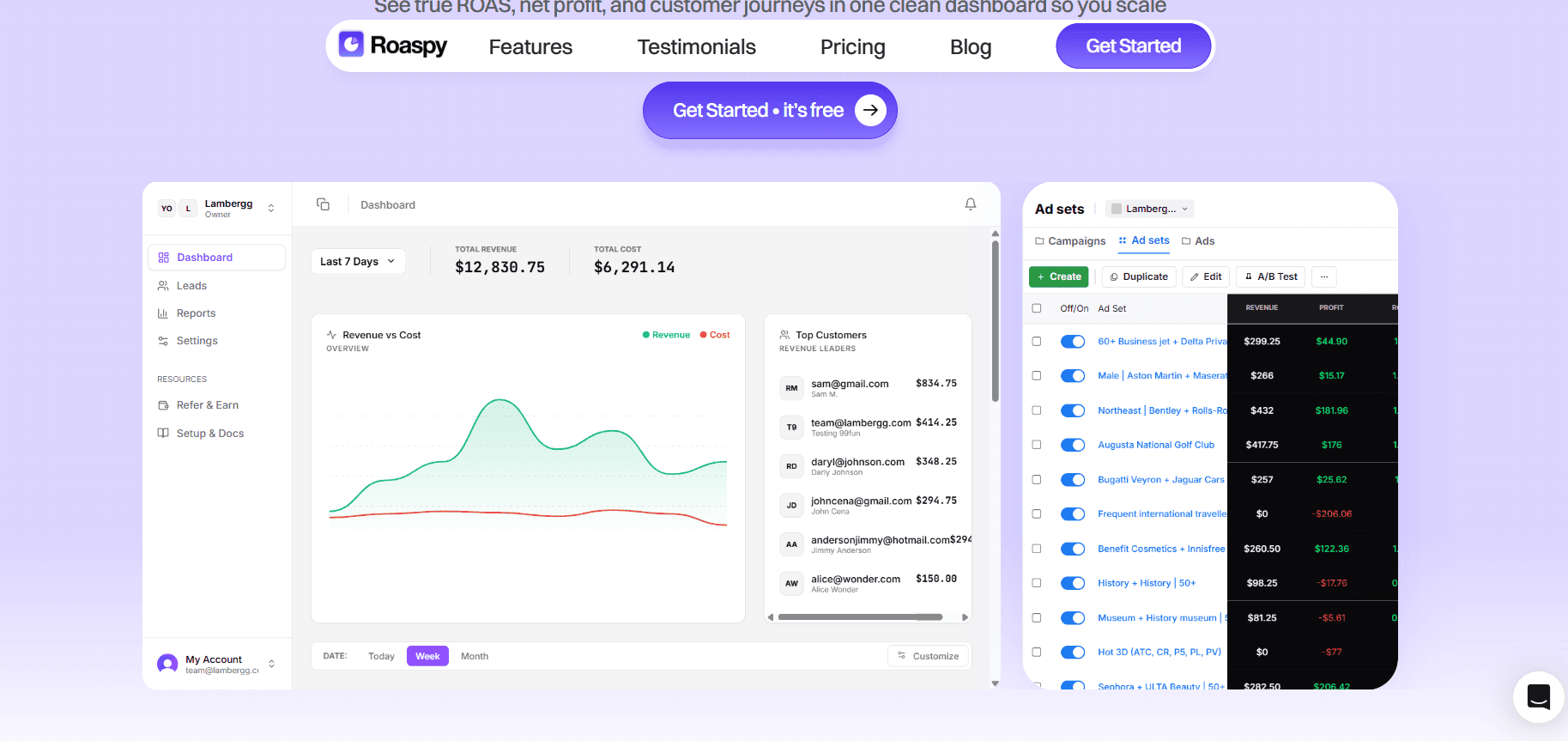
But the real reason I switched is that Roaspy was built specifically for webinar funnels and high-ticket info products. Not adapted for them, built for them. The 30-day attribution window is standard, not a configuration you have to unlock. The webinar registration tracking is native. The email-to-sale mapping works without extensive custom development. And the Facebook Ads Manager overlay lets me see attribution data directly inside the ad interface without jumping between platforms.
The first time I ran a webinar campaign through Roaspy, I found out that two ad sets I’d been pausing due to “low conversions” were actually responsible for purchases that came in on day 19 and day 26 of the attribution window. Facebook had stopped counting them. Roaspy caught them. That’s the kind of thing that changes your media buying decisions.
CAPI integration for iOS recovery is also built in, and the setup is genuinely simpler than what I went through with Hyros. I’m not a developer, and I set it up without needing to file a support ticket.
If you’re running a webinar funnel and you want attribution that’s accurate without the enterprise-level complexity or revenue-based pricing, I’d genuinely suggest checking out Roaspy at https://www.roaspy.com/.
Frequently asked questions
Q: Is Hyros worth the cost, specifically for webinar funnels?
A: NO for lean teams; YES for enterprise. If you don’t have a dedicated ops team and a 20-person sales floor, you are overpaying for complexity. For everyone else, it’s a technical drain on your focus.
Q: Can Wicked Reports track individual webinar registrants?
A: Technically yes, but it’s a headache. It requires manual event tagging and heavy email integration. If you want “click-to-close” visibility without the manual labor, it’s the wrong tool.
Q: What does webinar attribution software 2026 need to do that older tools didn’t?
A: The big additions are iOS 14+ recovery through CAPI, 30-day attribution windows for long sales cycles, and email-to-sale mapping that works even when someone changes devices between registration and purchase. The best webinar attribution software 2026 tools also need to handle replay views and post-webinar nurture tracking, not just registration and sale events.
Q: How do I track webinar ROI if I’m not technical?
A: Start simple. Make sure your registration event, your sale event, and your key mid-funnel events (replay view, offer page visit) are all tracked. Use a tool with a guided setup rather than one that requires custom script installation. Roaspy is the easiest setup I’ve worked with for this specific use case. You don’t need to be a developer to track webinar ROI accurately.
Q: Does Hyros handle the 30-day window well?
A: It’s capable, but flawed. While it supports 30 days, the default settings often miss the nuances of a webinar replay cycle. Roaspy handles this natively out of the box.
Q: What’s the main difference between Hyros vs Wicked Reports for webinars in practical terms?
A: Hyros tracks the journey at the individual level with strong call and phone-sale attribution. Wicked Reports tracks cohort-level LTV and is better for understanding recurring revenue patterns. For a straight webinar-to-sale funnel, neither is a perfect fit out of the box, which is exactly why I started using Roaspy.
My final thoughts
Here’s where I land after years of working with both of these platforms across real client accounts with real money on the line. Neither Hyros nor Wicked Reports is a bad tool. They’re both genuinely capable in the right context. The mistake I see people make is choosing based on brand reputation or a comparison blog (including ones like this) without matching the tool’s actual architecture to their specific funnel type.
If you’re running a high-ticket offer with phone sales and a sales team, do your full Hyros webinar tracking review before you commit. It’s probably worth the cost and the setup complexity. If you’re running a membership or continuity offer and you need to understand LTV by cohort, Wicked Reports for info products is the serious choice. Neither one is wrong in those specific contexts.
But if you’re a course creator, a solo operator, or an agency managing webinar funnels for info product clients, and you want clean attribution without a Success Tax, without enterprise setup requirements, and with CAPI recovery that actually works without a developer, then I’d send you to Roaspy. It’s what I use now. It solved the specific problems I kept running into with the bigger platforms, and the pricing doesn’t punish you for running successful campaigns.
The whole Hyros vs Wicked Reports for webinars conversation often misses the point that most webinar operators don’t need the most powerful tool on the market. They need the most accurate tool for their specific funnel. Accuracy beats complexity every time.
If you want to try what I use to track webinar ROI for the accounts I manage, go to https://www.roaspy.com/ and see how it fits your funnel. No pressure, but if you’ve been frustrated with attribution gaps and pricing that scales in the wrong direction, it’s worth 20 minutes of your time.