Introduction
ClickMagick is accurate for counting clicks. I’ll say that upfront. If you want to know how many people clicked your link, it delivers. But ClickMagick accuracy for Facebook ads in 2026 is a much bigger conversation than click counting, and this is where things get uncomfortable for a lot of people still using the tool. The Meta ecosystem has changed dramatically. iOS changes, cookie deprecation, browser privacy updates. Counting clicks is now maybe 10% of what tracking actually needs to do for your campaigns.
In this post, I’m going to walk through the full picture: what ClickMagick does right, where the ClickMagick vs Meta Pixel conversation exposes real gaps, and what Facebook ads tracking issues in 2026 actually look like on the ground for anyone running serious ad spend. I’ll also get into the ClickMagick review for agencies perspective, because it’s a different conversation when you’re managing multiple client accounts versus running your own solo offers. And I’ll tell you what I actually use now and why.
What ClickMagick actually does well
Let’s be fair to start. ClickMagick built its reputation on solid link tracking, bot filtering, and a reasonably clean interface. When it launched, it was genuinely one of the better tools available for affiliate marketers who needed to know which links were performing. The bot filtering is still legitimately good better than a lot of people give it credit for.
For basic split testing of landing pages, tracking which traffic source drove a click, and keeping affiliate links clean, it holds up. I used it myself for a period when I was managing campaigns for coaching clients. For the purpose it was originally designed for, it’s a decent product.
Pricing sits around $79–$349/month depending on your plan. Not outrageous. For someone doing straightforward affiliate work or early-stage testing, you can see why it still has users.
But here’s my honest take: the tool was built for a different era of the internet. When third-party cookies were everywhere and pixels fired reliably, tracking clicks and matching them to conversions was relatively simple. That world is gone.
ClickMagick accuracy for Facebook Ads: where it starts to break down
This is where I stop being generous.ClickMagick accuracy for facebook ads isn’t a question of whether the tool is broken. It’s a question of whether the problem it solves is still the right problem. And increasingly, it isn’t.
The core method ClickMagick uses is redirect-based link wrapping. Your traffic hits ClickMagick’s server, gets logged, then gets forwarded to your actual destination. In a world where page load speed directly affects ad conversion rates, that extra redirect step adds latency. How much? It varies. But on mobile, where most Meta traffic lands even 200–400 milliseconds of extra load time can quietly hurt your conversion rate without anyone pinpointing why.
I had this exact conversation with an agency owner managing around $80k/month on Meta. Their click data looked clean. Their ClickMagick dashboard looked healthy. But their reported conversions inside Ads Manager were running about 30% below what their actual sales were showing. That gap wasn’t a ClickMagick bug. It was a signal quality issue. The tool was counting clicks fine. The clicks just weren’t translating into properly attributed conversions because the signal loop back to Meta was weak.
That’s the hidden problem with ClickMagick accuracy for facebook ads in 2026. It’s not about the clicks. It’s about what happens after.
ClickMagick vs Meta Pixel: the signal quality problem nobody talks about
The ClickMagick vs. Meta Pixel debate is one that most blog posts completely miss. They treat it as either-or. It’s not.
The real question is: how well does your tracking tool push quality signals back to Meta’s algorithm? Because Meta’s AI doesn’t optimize on your dashboard data. It optimizes on what it receives through its own pixel and CAPI.
When people talk about ClickMagick vs. Meta Pixel, they often frame it as “which one is more accurate.” But that’s the wrong frame. The pixel tells Meta what happened on your site. CAPI (Conversion API) is what tells Meta with server-side certainty what happened, bypassing browser blocks and iOS restrictions. ClickMagick does have a CAPI integration, but it’s worth being direct: the implementation requires setup work that many advertisers and even some agencies don’t do correctly, and the data quality coming through that integration is inconsistent.
I’ve seen ClickMagick review for agencies threads on forums where the consistent complaint isn’t the click tracking itself. It’s the signal reliability back to Meta. When your CAPI data is noisy or delayed, you’re essentially starving Meta’s algorithm. Your ads technically run, but they optimize poorly because the machine learning doesn’t have clean fuel.
Facebook ads tracking issues in 2026 are fundamentally about signal quality, not click visibility.
Facebook Ads tracking issues in 2026 are bigger than click counting
Let me give you the full picture of what facebook ads tracking issues in 2026 actually look like.
The environment has changed in three major ways:
First, iOS privacy changes gutted browser-side pixel tracking. A large portion of your Meta audience, depending on your niche, potentially 40–60% is on Apple devices with ad tracking limited by default. If you’re not sending server-side events that match and supplement what the pixel misses, you’re flying partially blind.
Second, the Meta algorithm has become more dependent on conversion signals to optimize. In the early days of Facebook Ads, you could run traffic campaigns and let volume do the work. Now Advantage+ and the broader Meta AI optimization engine live and die on the quality of the conversion events it receives. Bad signals mean bad optimization. The ad might look fine on paper. The results won’t be.
Third, multi-touch attribution across longer funnels which is almost every info-product and coaching business requires actual customer journey data, not just click logs. Understanding that someone saw a YouTube ad, clicked a Meta retargeting ad three days later, and then converted after visiting your webinar replay page three times… that’s the data that tells you where to put your money. ClickMagick doesn’t give you that picture cleanly.
Honestly, this is where I see most people get it wrong. They think accurate tracking means knowing what was clicked. It means knowing the full path and feeding that intelligence back to the platforms doing the buying.
What accurate attribution for Meta Ads actually requires now
Accurate attribution for meta ads in 2026 needs three things working together.
A strong CAPI setup that sends server-side events reliably. Fingerprint-level visitor identification that can stitch together sessions even when cookies fail. And a clean, deduplicated signal back to Meta so the algorithm isn’t double-counting or getting confused by noisy data.
The deduplication piece is something I rarely hear discussed. When you run both browser pixel events and CAPI events simultaneously (which you should), there’s a risk of Meta counting a single conversion twice. Proper deduplication using event IDs is what prevents that. It’s a technical detail that has real consequences on your reported ROAS and your campaign optimization.
Achieving accurate attribution for meta ads isn’t just about installing a tool and walking away. It’s about the architecture of how your data flows.
For ClickMagick review for agencies purposes specifically: if you’re managing multiple client accounts, you also need a tool that scales cleanly across accounts without requiring you to rebuild the setup from scratch every time. That overhead matters.
ClickMagick alternatives worth considering
There are a few ClickMagick alternatives worth knowing about, and I’ll be honest about what each actually costs you in money and time.
HYROS is the one people often mention first. It’s positioned as AI-driven attribution for coaches and info-product businesses. The tracking is genuinely good. But the pricing starts around $230/month and scales up quickly. For a solo operator or a smaller agency, that’s a real commitment. And the onboarding is heavy.
Segmetrics sits in a similar premium range, SegMetrics’ Launch plan starts at $57/month, with its Grow plan at $197/month, still a significant commitment for smaller operators. It’s built specifically for info-product and course businesses, which I respect. The funnel visualization is solid. But again, the price point puts it out of reach for a lot of people who need accurate attribution for meta ads without the enterprise cost.
RedTrack and ClickMagick are closer competitors on price. RedTrack starts around $149/month and has better multi-channel attribution than ClickMagick in my experience. It’s worth looking at as a ClickMagick alternative if you’re already thinking about switching.
Roaspy is where I’ll spend more time in the next section, but the short version: it offers full-funnel tracking with CAPI integration for both Meta and Google Ads, FingerprintJS technology for cookieless attribution, and every feature on every plan. Pricing starts considerably lower than HYROS or Segmetrics. No gated features. No “upgrade to see the good stuff.”
Out of all these, Roaspy is the best alternative in every aspect; price, features, workflow, and accuracy.
Why I switched to Roaspy vs ClickMagick for my own campaigns
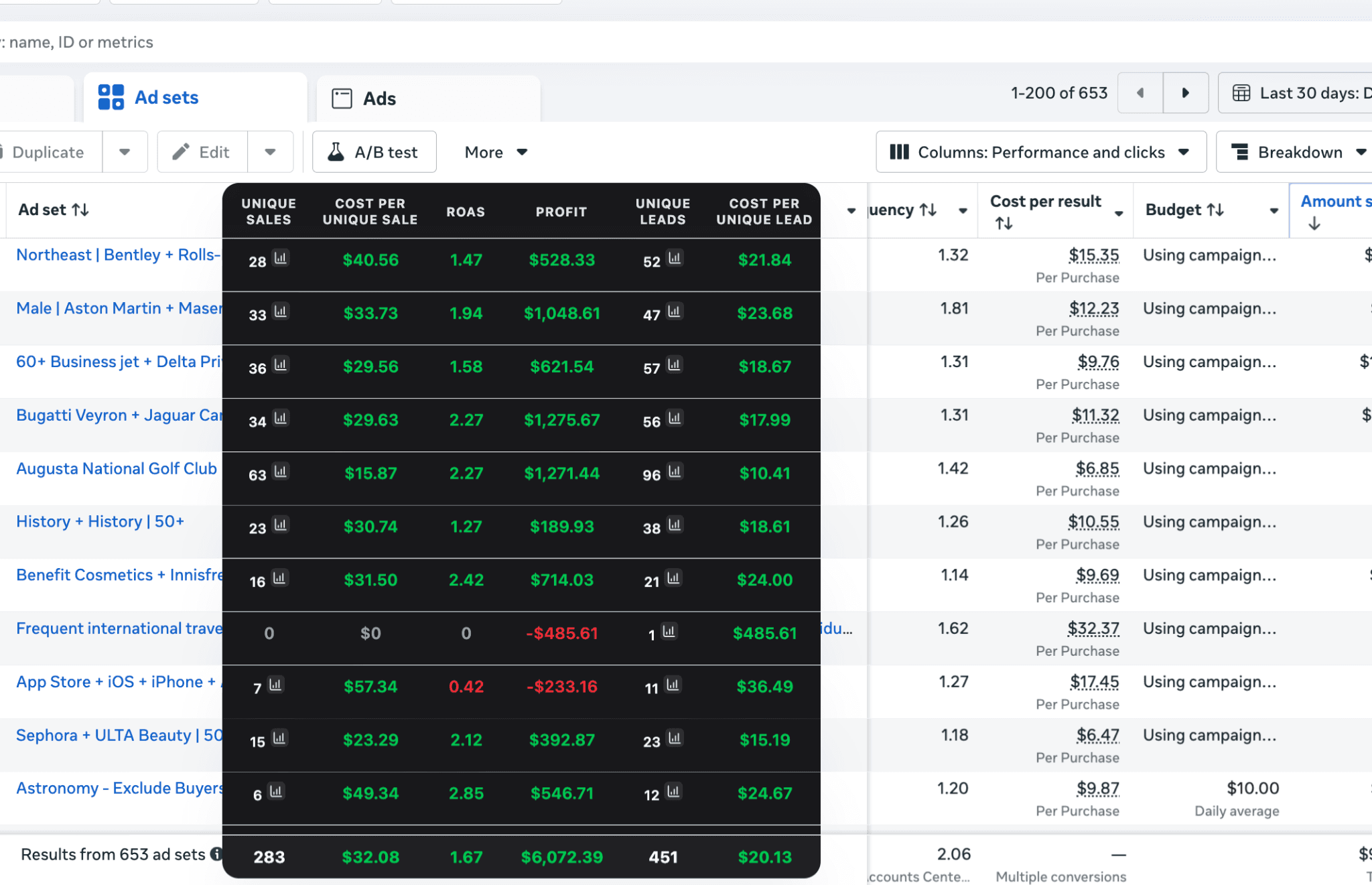
When I started evaluating Roaspy vs ClickMagick seriously, the thing that sold me wasn’t a feature list. It was the Chrome extension.
Think about your actual workflow when you’re managing campaigns. You’re inside Ads Manager. You’re looking at ad sets, checking costs, evaluating which creatives are working. With ClickMagick, your “accurate” data lives in a separate tab. You constantly context-switch between your tracker and Ads Manager, trying to mentally reconcile two different sets of numbers. That friction is real, and it compounds over time.
With Roaspy, the data surfaces directly inside Ads Manager through the Chrome extension. Real-time attribution, customer journey data, conversion truth right there in the interface where you’re already making decisions. That alone changed how I work.
Feature | Roaspy | ClickMagick |
Tracking Method | FingerprintJS | Redirect link wrapping |
CAPI Integration | Meta + Google Ads, native | Available, setup-heavy |
Chrome Extension (in Ads Manager) | Yes | No |
Full-Funnel Customer Journey | Yes, all plans | Limited |
Bot Filtering | Yes | Yes |
Gated Features | None | Some features plan-dependent |
Starting Price | $47/mo (Free for ad spend less than 1500) | ~$79/month |
Page Load Impact | None (no redirect) | Adds redirect latency |
Best For | Agencies, coaches, info-product | Affiliates, basic link tracking |
The FingerprintJS technology is the other part. Rather than relying on redirect links (which slow page loads) or cookies (which iOS blocks), Roaspy uses device fingerprinting to identify visitors reliably across sessions. For accurate attribution for meta ads in a post-cookie world, that’s not a nice-to-have. It’s the whole game.
I’ll be direct: I was frustrated with the data inconsistencies I was seeing before I found this approach. The Roaspy vs ClickMagick comparison for me came down to one question: which tool is actually built for how Meta works today, not how it worked in 2019.
If you’re running Facebook Ads and you care about feeding clean signals back to Meta’s algorithm, check it out at Roaspy.com. The setup is cleaner than anything I’ve worked with at this price point.
Frequently asked questions
Q: Is ClickMagick accurate for Facebook Ads in 2026?
A: It’s accurate for counting clicks, yes. But ClickMagick accuracy for facebook ads in the context of what actually matters in 2026. Signal quality back to Meta, cookieless attribution, CAPI reliability is where it shows its age. Clicks are only a small part of the tracking puzzle now.
Q: What’s the difference between ClickMagick vs Meta Pixel?
A: They serve different purposes. The Meta Pixel fires on your site and reports browser-side events back to Meta. ClickMagick tracks link clicks and routes traffic. The ClickMagick vs meta pixel question really becomes important when you realize neither one alone gives you reliable server-side CAPI signals, which is what Meta’s algorithm actually needs to optimize well.
Q: Is Roaspy vs ClickMagick a fair comparison for agencies?
A: From a ClickMagick review for agencies perspective, it depends on what your clients need. If they’re running straightforward affiliate traffic, ClickMagick might still be fine. If they’re running Facebook Ads for info-products, coaching, or high-ticket offers where full-funnel attribution and CAPI signal quality matter, Roaspy vs ClickMagick isn’t close Roaspy is purpose-built for that environment.
Q: What are the main facebook ads tracking issues in 2026?
A: The biggest facebook ads tracking issues in 2026 are iOS tracking restrictions, cookie blocking by browsers, poor CAPI signal quality, and the inability to see the full customer journey across touchpoints. These aren’t ClickMagick-specific problems, but they do expose why redirect-link-based trackers have limitations.
Q: Are there reliable ClickMagick alternatives that cost less than HYROS?
A: Yes. Roaspy is the one I use and recommend. Among the ClickMagick alternatives, it offers FingerprintJS tracking, CAPI for Meta and Google, a Chrome extension for in-Ads Manager attribution, and full features on every plan at a fraction of what HYROS or Segmetrics charge.
Q: Does ClickMagick slow down landing pages?
A: The redirect link wrapping method does add a small latency hit before users reach your landing page. It’s not massive, but on mobile where most Meta traffic lands any added load time can quietly hurt conversions. Tools that use non-redirect tracking methods (like Roaspy’s FingerprintJS approach) avoid this entirely.
My final thoughts
Here’s where I land on this: ClickMagick isn’t a bad tool. It’s a mismatched tool for where Facebook Ads tracking actually lives in 2026. The platform was designed for a click-tracking problem that has evolved into a signal-quality and full-funnel attribution problem. Those are fundamentally different challenges.
I spent years managing serious ad budgets over $10M in spend across my own businesses and client accounts. The lesson I kept learning the hard way is that your data infrastructure determines your ability to scale. If you’re making optimization decisions on incomplete or poorly attributed data, you’re not running a business. You’re running a guessing operation with expensive consequences.
The facebook ads tracking issues in 2026 that matter most aren’t the ones you can see in a click report. They’re the ones quietly degrading your Meta algorithm’s ability to find your buyers. That’s what ClickMagick accuracy for facebook ads doesn’t address, and that’s the conversation I think more people need to be having.
If you’re an agency owner, a coach, or an info-product creator who’s tired of reconciling numbers across three different dashboards and wondering why your Ads Manager ROAS doesn’t match your actual revenue that’s exactly the problem Roaspy was built to fix. The Chrome extension alone is worth the switch for how it changes your daily workflow inside Ads Manager.
Go try it yourself at Roaspy.com. The difference between seeing data in a separate tab and seeing the truth directly inside your Ads Manager is hard to explain until you’ve experienced it. Then you won’t go back.