Introduction
If you’re running Facebook ads in 2026 and still using ClickMagick, you’re working with a tool that was built for a world that no longer exists. The best ClickMagick alternative for Facebook ads right now is Roaspy, and it’s not particularly close. Roaspy was built specifically for the post-iOS 14 environment, integrates directly into your Ads Manager via a Chrome extension, and uses FingerprintJS combined with native CAPI to send verified conversion data back to Meta’s algorithm. That’s not a feature list. That’s a fundamentally different approach to Facebook ads attribution.
In this post, I’m going to break down exactly why the old link-tracking model is costing you money, what a modern Facebook ad tracking software actually looks like, and how Roaspy solves the specific problems that ClickMagick was never designed to handle. I’ve managed over $10M in ad spend across agencies and my own businesses, and I’ve felt every version of this pain. What follows is my view, not a polished vendor comparison.
The iOS 14+ problem that broke ClickMagick’s workflow
Here’s the honest truth: ClickMagick wasn’t built for what Facebook advertising became after 2021.
Before iOS 14, link tracking was pretty straightforward. You wrapped a URL, passed click IDs through, and matched conversions on the backend. It worked well enough. ClickMagick thrived in that environment. But iOS 14 changed everything. Suddenly, you had signal loss, delayed reporting, and a growing gap between what Meta’s Ads Manager showed and what was actually happening in your payment processor. The browser-based tracking and redirect methods that ClickMagick relies on started crumbling under the weight of cookie restrictions, browser privacy updates, and Apple’s ATT framework.
I remember running a campaign for a coaching client back in 2022 where ClickMagick was showing 40 conversions, and the actual CRM showed 19. That gap wasn’t a rounding error. It was a business decision waiting to be made wrong.
Fix Facebook ad reporting correctly, and you fix your entire scaling strategy. When your numbers are wrong, your budget decisions are wrong. Your bid strategy is wrong. Your creative testing conclusions are wrong. Everything downstream breaks. The old redirect-based model for Facebook ad tracking software simply can’t keep up with how privacy regulations and browser behavior have evolved. That’s not an opinion. It’s just what the data shows.
Why Facebook ad tracking software needs to live inside Ads Manager
I’ve said this before, and I’ll keep saying it: media buyers live inside Meta Ads Manager. That’s where decisions get made.
When you’re managing campaigns at scale, you’re constantly toggling between ad sets, checking CPAs, comparing creative performance, and adjusting budgets. The last thing you need is to open a second tab, log into a separate dashboard, cross-reference campaign IDs, and try to reconcile numbers that were generated minutes or hours apart. That friction adds up. Badly.
This is one of the biggest workflow problems with using ClickMagick as your Facebook ads attribution tool. The interface is separate. The data is separate. You’re constantly context-switching, and every context switch costs you time and increases the chance of making a decision based on stale or mismatched data. When you’re tracking Meta ads ROI across dozens of ad sets, that’s not a minor inconvenience. It’s a systemic problem.
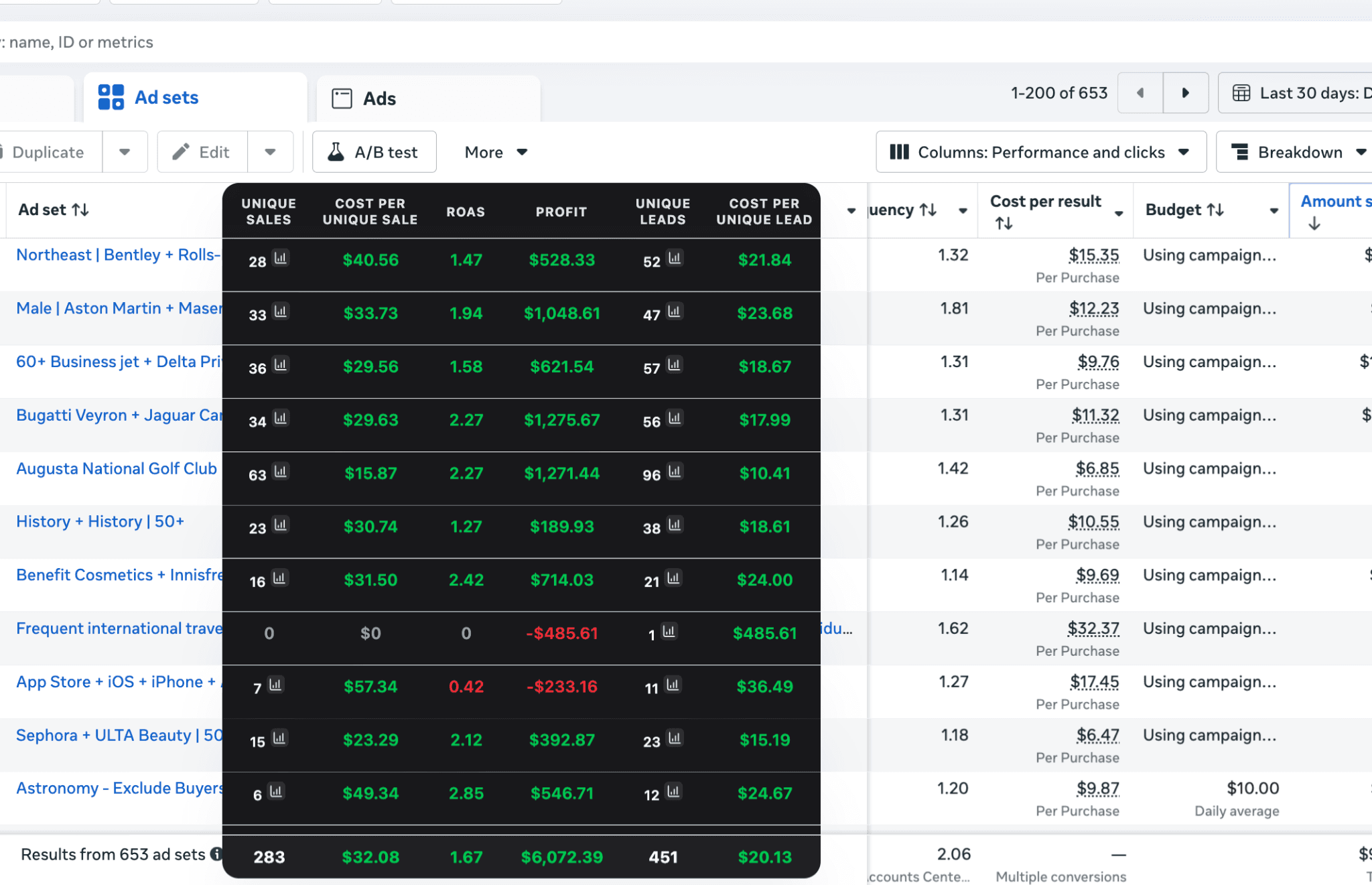
Roaspy solves this with a Chrome extension that puts verified attribution data directly inside your Ads Manager rows. Real purchase values, real conversion counts, right next to Meta’s reported numbers. You see the discrepancy and the truth in the same view. I can’t overstate how much this changes the day-to-day workflow. It’s the difference between navigating with a GPS and navigating with a paper map that’s three years old.
Roaspy vs ClickMagick: a head-to-head breakdown
Let’s get into the specifics. In the Roaspy vs ClickMagick conversation, pricing is where things get interesting fast.
ClickMagick’s plans start at around $79/month for their Standard tier, and their Pro plan runs $199/month. At those price points, you’d expect native CAPI integration and Ads Manager-level visibility. You don’t get either. What you get is link tracking, funnel reporting in a separate dashboard, and a workflow that feels like it was designed for affiliate marketers running solo offers in 2018. Not knocking that use case, but it’s not what most Meta advertisers need today.
Feature | Roaspy | ClickMagick |
Pricing | $47/mo(free upto $1500 ad spend) no gated features on any plan | Starts at $79/mo, advanced features locked to higher tiers |
Chrome Extension (Ads Manager View) | Yes (Real-time data inside Ads Manager rows) | No |
Native CAPI Integration | Yes (Meta and Google) | Limited, requires workarounds |
FingerprintJS Tracking | Yes | No |
Full-Funnel Attribution | Yes (On all plans) | Partial, depends on tier |
Dashboard Location | Inside Ads Manager + Standalone | Separate dashboard only |
Built for Post-iOS 14 | Yes | Partial adaptation |
Best For | Facebook/Meta advertisers, agencies, coaches | Affiliate marketers, link tracking use cases |
The Roaspy vs ClickMagick comparison really comes down to this: one tool was built for link tracking and adapted (imperfectly) to the Meta ads world, while the other was built specifically for modern Facebook advertising from the ground up.
The real cost of bad attribution
Nobody talks about this enough. Bad data doesn’t just give you wrong numbers. It actively trains Meta’s algorithm to optimize for the wrong things.
When your Facebook ads attribution tool isn’t sending accurate conversion signals back to Meta, the algorithm doesn’t know what a real buyer looks like. It’s learning from noise. You end up with campaigns that look efficient on paper and bleed money in reality. I’ve seen this pattern so many times with clients who came to me confused about why their ROAS looked great inside Ads Manager, but their revenue was flat or declining.
Fix Facebook ad reporting, and you’re not just improving your dashboard view. You’re feeding better data back into Meta’s machine learning engine. That’s where the real leverage is. When I was scaling a publishing business to over $1M/month, the single biggest unlock wasn’t better creative or better targeting. It was cleaner data. Better signals. Fewer discrepancies between what the platform thought was happening and what was actually happening in the real world.
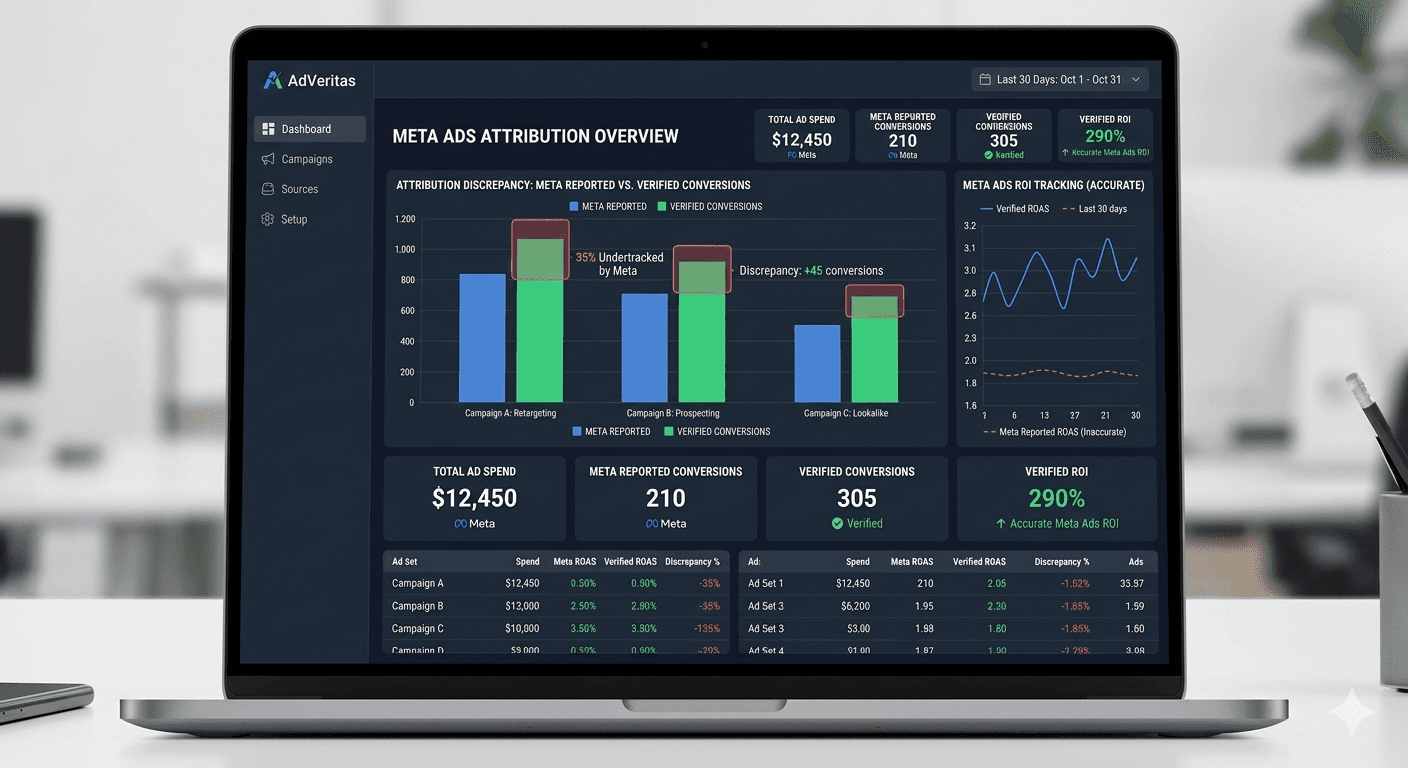
Tracking Meta ads ROI accurately is a competitive advantage. Not just operationally, but algorithmically.
FingerprintJS and CAPI: the technical edge that actually matters
ClickMagick uses redirect-based tracking as its core mechanism. A user clicks a link, gets routed through ClickMagick’s servers, and lands on your page. Conversion data is then matched and reported back. That system worked before browsers started aggressively blocking third-party cookies and before iOS privacy updates made device-level tracking unreliable.
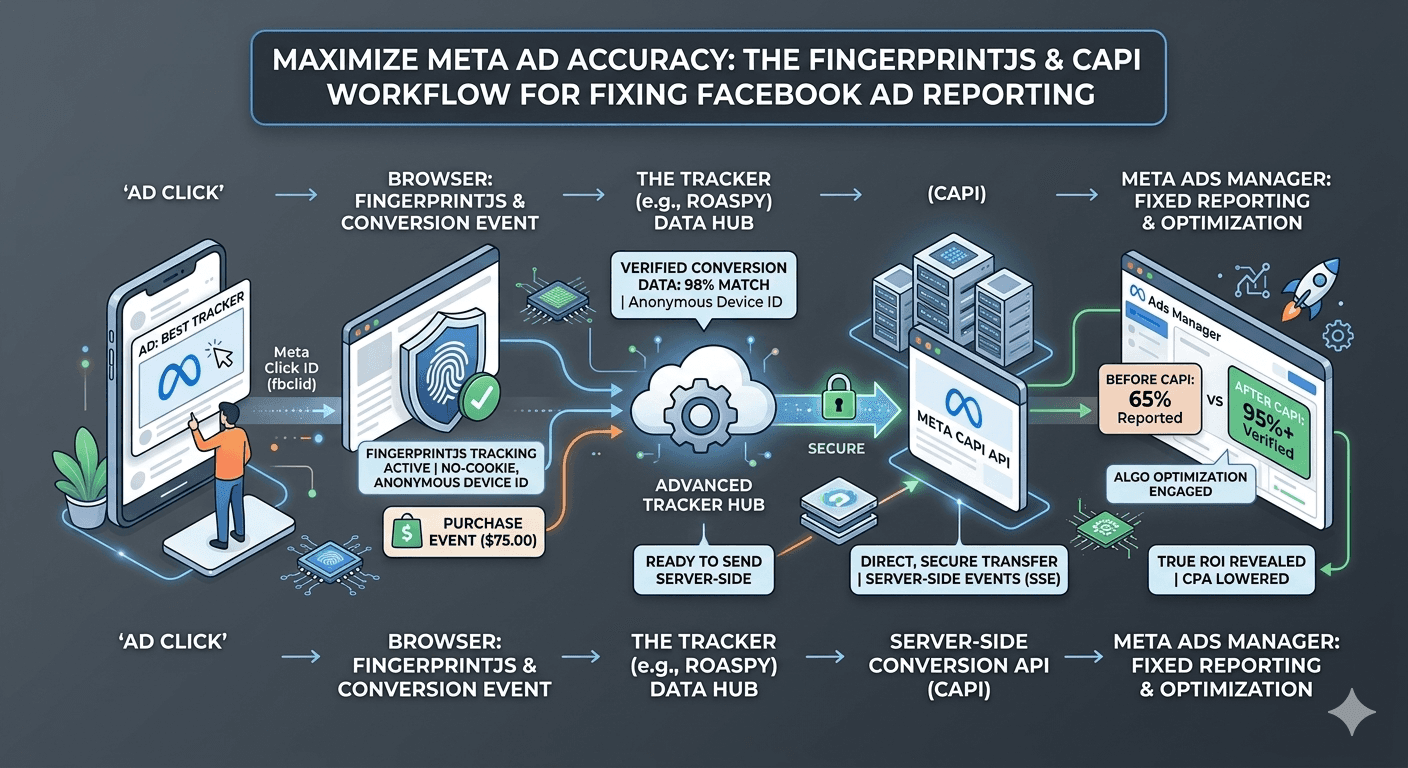
Roaspy uses FingerprintJS, which creates a stable, privacy-compliant browser fingerprint that doesn’t rely on cookies. This means you can track users more accurately across sessions even when cookies are blocked or cleared. Pair that with native CAPI integration, and you have a system where verified conversions are sent directly from your server to Meta’s Conversion API, bypassing browser limitations entirely.
This matters for two reasons. First, your best tracker for Meta ads needs to capture conversions that would otherwise disappear. Every missed conversion is a missed signal for the algorithm. Second, when you’re actually sending those conversions back via CAPI with high event match quality, Meta’s algorithm gets smarter about who to target. You’re not just measuring performance. You’re improving it.
Honestly, this is where I see most people get it wrong. They treat tracking as a reporting function when it’s actually an optimization function. The best tracker for Meta ads doesn’t just tell you what happened. It helps the platform find more people like your buyers.
Why I recommend Roaspy for tracking Meta ads ROI
I covered this briefly in a recent video (Our Ads Tracking Is 100% Accurate (This Is How We Did It)), but the short version is: I started using Roaspy after one too many campaigns where the numbers simply didn’t add up.
As a Facebook ads attribution tool, Roaspy does something that most of its competitors either can’t do or charge a premium for: it makes the data visible exactly where you need it, without requiring you to rebuild your entire stack. The Chrome extension alone is worth the switch. Seeing verified purchase data directly inside my Ads Manager rows, right next to Meta’s reported numbers, changed how I review campaigns.
At its price point (with full features available on all plans, no feature gating), it’s genuinely the best value in the market for a serious Facebook ad tracking software. Tools like HYROS and Segmetrics can run $300 to $600+ per month at scale. ClickMagick’s Pro tier is $199/month and still doesn’t give you Ads Manager-native visibility or proper CAPI integration. Roaspy delivers more of what actually matters for Meta advertisers at a fraction of the cost.
The best tracker for Meta ads should give you data you can act on, in the place where you make decisions, with the accuracy to trust it. That’s what Roaspy does.
If you want to try it yourself, head over to roaspy.com and see what your actual numbers look like.
Frequently asked questions
Q: Is Roaspy really a better ClickMagick alternative for Facebook ads, or is it just different?
A: It’s genuinely better for Facebook and Meta-specific use cases. ClickMagick is a solid link tracker that has broader use cases (like affiliate tracking), but if your primary channel is Meta ads and you need accurate attribution with CAPI, the comparison isn’t close. Roaspy was built specifically for this problem.
Q: Do I need to be technical to set up Roaspy’s CAPI integration?
A: No, and that’s actually one of the things I appreciate about it. The CAPI setup is straightforward, and the Chrome extension installs in minutes. You don’t need a developer to get it working. Most of the people I recommend it to are media buyers and solo operators, not engineers.
Q: What’s the actual difference between fixing Facebook ad reporting with CAPI versus using pixel-only tracking?
A: The pixel relies on the browser, and browsers are increasingly unreliable due to ad blockers, cookie restrictions, and iOS privacy changes. CAPI sends conversion data directly from your server to Meta, so it doesn’t get blocked. The combination of both gives you the highest possible event match quality, which directly improves how Meta’s algorithm optimizes your campaigns.
Q: Can Roaspy replace ClickMagick entirely, or do I need both?
A: For Meta and Google Ads campaigns, Roaspy replaces ClickMagick entirely and then some. If you have specific affiliate tracking use cases or need deep link management outside of paid social, you might keep a separate tool for that. But for most coaches, agency owners, and info-product businesses running Facebook ads, Roaspy covers everything you actually need.
Q: How does Roaspy’s pricing compare to ClickMagick for someone just getting started?
A: ClickMagick starts at $79/month for their basic plan, with the features most Meta advertisers actually need sitting behind the $199/month tier. Roaspy doesn’t gate features by plan, so you get full-funnel tracking and CAPI access regardless of which tier you’re on. For what you get, it’s significantly better value.
Q: Is FingerprintJS privacy-compliant?
A: Yes. FingerprintJS creates a browser fingerprint without storing personally identifiable information in a way that violates GDPR or CCPA. It’s a privacy-respecting method of improving tracking accuracy in a post-cookie environment. Roaspy uses it specifically to improve attribution without running into the legal and ethical issues that come with older tracking methods.
My final thoughts
Look, I’ve been doing this long enough to know that most people switch tracking tools for the wrong reasons. They chase features on a comparison table instead of asking the real question: does this tool help me make better decisions faster?
The reason I keep coming back to Roaspy as the best ClickMagick alternative for Facebook ads isn’t just the technology, though the FingerprintJS and CAPI combination genuinely is superior for Meta advertisers. It’s the workflow. When your Facebook ad tracking software lives inside the place where you actually work, you make better decisions. You catch problems earlier. You scale winners faster because you trust the numbers you’re looking at.
I’ve managed over $10M in ad spend, scaled a publishing business to over $1M/month, and eventually sold it for seven figures. If there’s one thing that thread has in common, it’s that good data was always upstream of good decisions. You can’t fix bad data with better creative. You can’t out-target inaccurate attribution. You have to fix the foundation first.
If you’re still using ClickMagick, you haven’t seen what Roaspy can do for your Facebook ads yet. Go try it at https://roaspy.com and stop making media buying decisions on guesswork.