Introduction
Is SegMetrics worth it for a small business? For most small teams running lean budgets, the honest answer is: probably not. SegMetrics is a genuinely powerful attribution platform, but it’s built with a complexity and pricing model that assumes you have a dedicated ops person, an established email list driving meaningful revenue, and enough margin to absorb $57 per month before you’ve confirmed the tool is actually changing your decisions. That’s a big assumption for a team of two or three people trying to figure out which ad is pulling its weight.
What I want to do in this post is give you a real SegMetrics review 2026 that isn’t just a feature list dressed up as analysis. I’ve audited attribution stacks for a lot of small and mid-sized businesses, and I’ve watched owners make the same mistake: they buy the most sophisticated tool they can find, spend three weeks integrating it, and then open the dashboard once a week to feel smart. That’s not attribution. That’s expensive wallpaper. I’ll walk through what SegMetrics genuinely does well, where it falls short for smaller operations, and why affordable ad tracking for small biz requires a very different calculus than what most tool reviews will tell you.
What SegMetrics actually does (and who it’s built for)
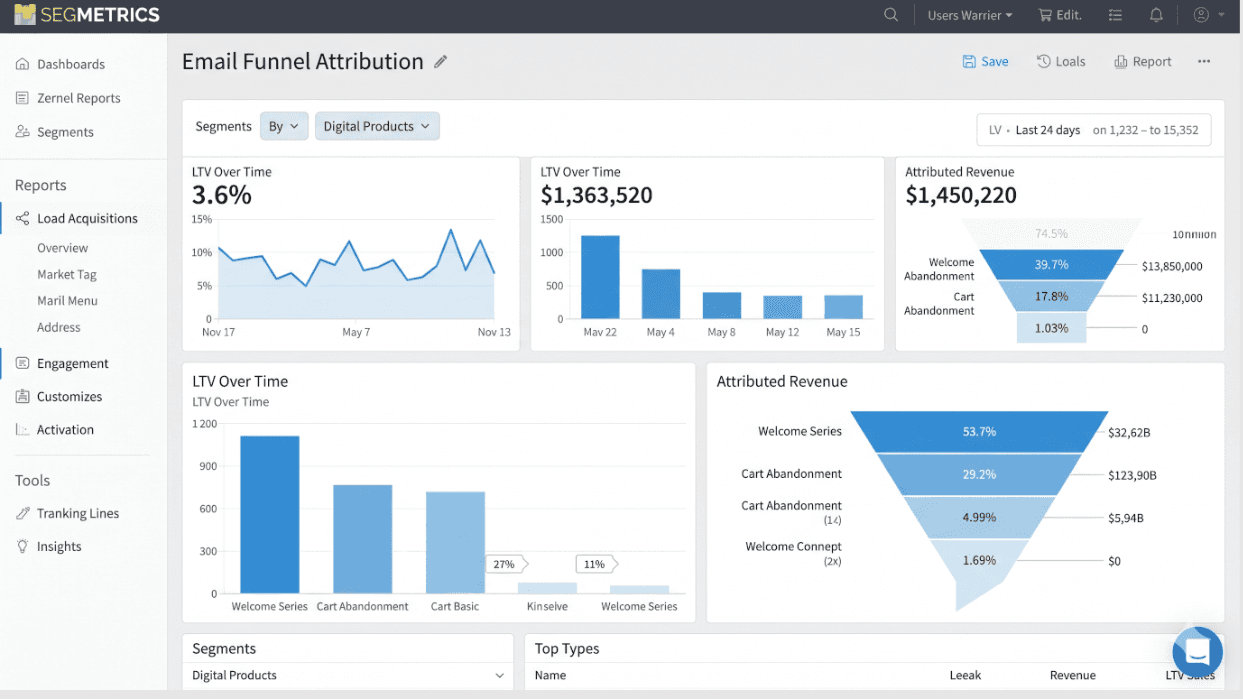
SegMetrics is an attribution platform designed around email-driven funnels. If you’re running a course business or a membership product where someone joins your list, gets nurtured over weeks, and then buys, SegMetrics is genuinely built for that journey. It connects your email platform (Klaviyo, ActiveCampaign, ConvertKit) directly to your payment processor, maps the full customer path, and gives you revenue attribution that goes beyond last-click.
That’s legitimately useful. Most ad platforms report last-click by default, which means your email sequence gets zero credit even if it did all the heavy lifting. SegMetrics fixes that.
But here’s what nobody says loudly enough: this tool is designed for businesses where email is the primary acquisition channel, the nurture sequence is complex, and someone on the team actually has bandwidth to interpret funnel analytics reports. That is not the typical small business. Most of the small businesses I work with are running Facebook and Google ads, have a simple opt-in or product page, and need to know one thing: which ad made me money today?
Honestly, every SegMetrics review 2026 I’ve read spends too long on features and not enough time asking, “Who is this actually for?” The answer, when you look closely, is digital product creators with established audiences and multi-step funnels. If that’s you, great. If you’re still building your audience, or you’re a DTC brand, or you just need clean channel attribution, this tool will feel like overkill before you’re even done setting it up.
Is SegMetrics worth it for a small business? Let’s talk pricing
SegMetrics pricing for startups is where the conversation gets uncomfortable. Their plans start at $57 per month. That’s not a trial tier or a stripped-down version; that’s the entry point. For a business spending $2,000 to $5,000 per month on ads, that’s a meaningful chunk of your analytics budget going to one tool before you’ve even confirmed it’s giving you decisions you wouldn’t otherwise make.
I’ve had clients come to me after three months on SegMetrics and say some version of the same thing: “The data is interesting, but I’m not sure I’ve changed anything because of it.” That’s the trap. When you’re evaluating SegMetrics pricing for startups, you’re not just evaluating the monthly fee; you’re evaluating the opportunity cost of your own time to configure it, the mental load of learning another reporting layer, and the ongoing cost of maintaining it.
Compare that to what you actually need at the sub-$5k ad spend stage: clean channel attribution, email-to-sale mapping, a 30-day window that doesn’t cut off conversions prematurely, and server-side tracking so iOS changes don’t gut your data. Those are the non-negotiables. Most affordable ad tracking for small biz options deliver these at a fraction of $57 per month.
A client asked me last month whether SegMetrics pricing for startups was justified if they were only doing $8k per month in revenue. My answer was no. Not because SegMetrics is bad software, but because at that stage, you need clarity, not complexity.
The “technical debt” problem nobody warns you about
This is the section I wish someone had written for me five years ago.
Technical debt in marketing analytics is what happens when you build a reporting stack that’s more complex than your team can actually maintain. SegMetrics, like most enterprise-adjacent tools, requires real integration work. You’re connecting your email platform, your CRM, your payment processor, and possibly your ad accounts. Each connection is a potential breaking point. When something stops working, you often won’t notice right away, because the dashboard still shows numbers, just wrong ones.
I’ve audited setups where a SegMetrics integration had been silently miscounting conversions for six weeks because a payment processor webhook failed. The owner had no idea. They were making budget decisions on corrupted data and feeling good about it because the dashboard looked polished.
Is SegMetrics worth it for small business teams that don’t have a dedicated analytics person? I’d argue no, and this is why. The tool assumes a level of ongoing maintenance that small teams genuinely can’t sustain. It’s not a criticism of SegMetrics specifically; it’s just the reality of what happens when you adopt enterprise-grade infrastructure without enterprise-grade support capacity.
Affordable ad tracking for small biz should come with low maintenance overhead as a core feature, not an afterthought. Simple, server-side, and self-healing where possible. That’s the standard I hold every tool to now.
Where SegMetrics genuinely shines
I don’t want this to read like a hit piece, because it isn’t. There’s a real use case where SegMetrics earns every dollar of its cost.
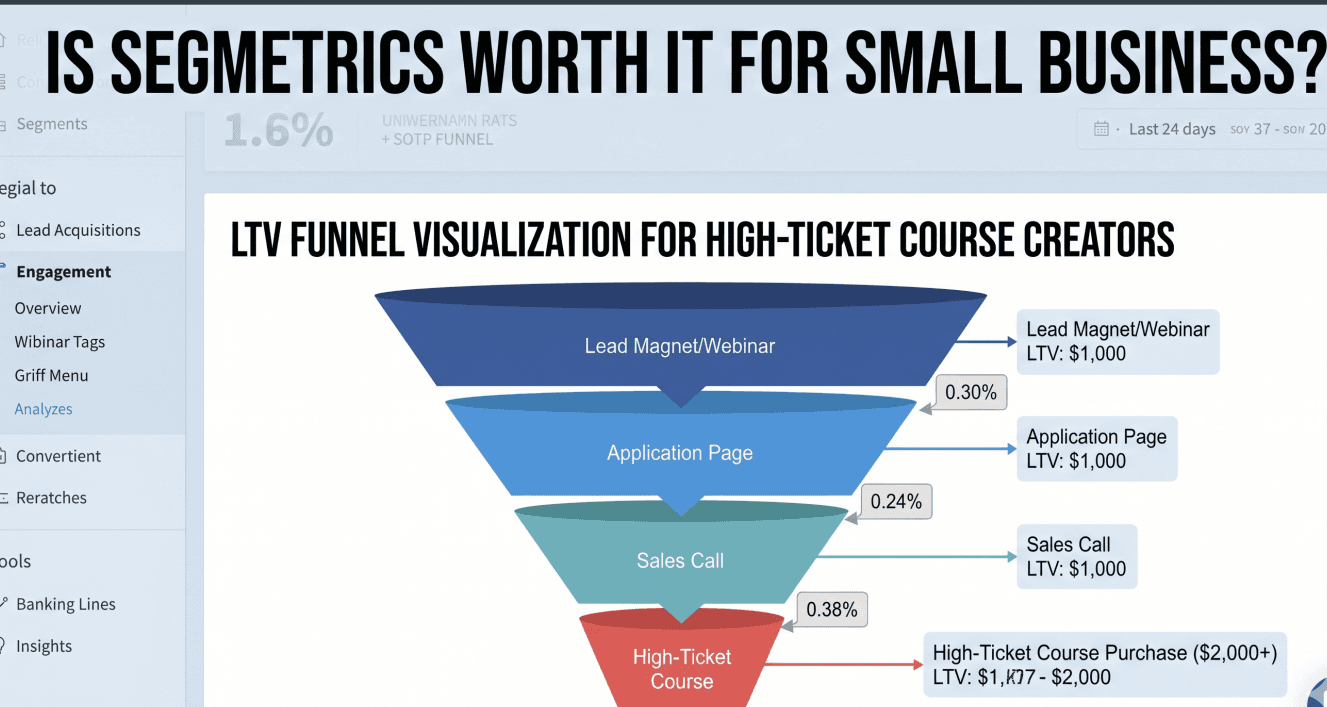
If you’re a high-ticket course creator doing $50k or more per month, with an established email list of 20,000 or more subscribers, and your sales team is running follow-up sequences over 30 to 60 days, SegMetrics gives you something genuinely hard to find elsewhere: full LTV visibility mapped back to the original lead source. You can see that your Facebook ad leads convert at a different rate than your YouTube leads, and that the difference only shows up at day 45 of the nurture sequence. That’s actionable intelligence that changes your acquisition strategy.
The Klaviyo and ActiveCampaign integrations are strong. The funnel analytics visualizations are genuinely good. The upsell and refund tracking is a feature I haven’t seen replicated cleanly in lighter tools.
But notice the profile I just described. $50k+ per month. Large list. Multi-step high-ticket funnel. That’s not a startup. That’s not even most mid-sized businesses. For a SegMetrics review 2026, to be honest, it has to acknowledge that the tool is correctly priced and correctly featured for a specific tier of business, and that tier is higher than most small business owners are at right now.
Roaspy vs SegMetrics for small teams: the honest comparison
Here’s where I want to be genuinely useful rather than just critical.
When I think about Roaspy vs SegMetrics for small teams, the comparison isn’t really about features on paper. It’s about what problem you’re actually trying to solve today, with the resources you actually have.
Feature | Roaspy | SegMetrics |
Starting Price | Free (up to $1,500 ad spend) / $47/mo | ~$57/month |
Free Tier | Yes (Permanent) | No |
Revenue Success Tax | None (Flat Rate) | None |
Server-Side CAPI | Yes (Built-in Perfection) | Partial / High Config |
Email-to-Sale Journey | Yes (Native Journey Mapping) | Yes (Core focus) |
Attribution Window | 1-Year+ (Full LTV Focus) | Up to 1 Year+ |
Setup Complexity | Simple, Self-Serve (Instant) | Moderate to Complex |
Agency Reporting | Yes (Advanced Agency Features) | Limited |
Best For | Coaches & Course Creators ($5k–$100k+) | High-ticket brands needing deep modeling |
The Roaspy vs SegMetrics for small teams question has a pretty clean answer when you lay it out like this. Roaspy covers the essential attribution needs, email-to-sale mapping, server-side tracking, and 30-day windows, at a price that doesn’t punish you for being small.
SegMetrics asks you to pay for infrastructure before you’ve outgrown simpler options. For most small teams, that’s the wrong order of operations.
When evaluating SegMetrics pricing for startups against Roaspy’s $47 starting point, the math is stark. You’d pay an extra $10 per month for complexity you probably don’t need yet. That’s real money for a lean team.
How Roaspy fits into this
Roaspy is the tool I reach for first when I’m working with a small business or course creator who needs attribution data that actually changes decisions, not just fills a dashboard.
What it solves is specific: you’re running ads, you have an email sequence, and you can’t tell which ad is actually driving the sales that show up three weeks later. That gap, between click and conversion, is where most small business ad budgets leak. Roaspy maps that journey using server-side CAPI integration, so you’re not dependent on browser cookies that iOS updates have made unreliable. The 30-day attribution window means a lead who converts on day 22 still gets credited back to the right campaign.
I started leaning on Roaspy after watching a client pause a campaign that was actually their best performer, because last-click data made it look like it wasn’t converting. The email sequence was doing the work, and no one could see it. That’s a fixable problem, and Roaspy fixes it without requiring a data engineer or a $57/month commitment before you’ve even validated the setup.
The permanent free tier up to $1,500 in ad spend is something I genuinely appreciate. It means a brand-new business can verify that the tracking is working, see the email-to-sale journey data, and build confidence in the numbers before spending a dollar on the tool itself. Paid plans start at $47/month, no revenue percentage taken, no success tax as your business grows.
The dashboard is minimal by design. That’s intentional, and it’s the right call. When I’m doing Roaspy vs SegMetrics for small teams evaluations, the simplicity isn’t a weakness; it’s the point. You want fast clarity, not more tabs to ignore.
If you’re running ads and you don’t have clean attribution right now, start here: https://Roaspy.com/
Frequently asked questions
Q: Is SegMetrics worth it for small business owners just starting out with paid ads?
A: Generally, no. If you’re in the early stages, the $57/month entry price and integration complexity will create more overhead than insight. Start with a lighter, more affordable ad tracking for small biz option and graduate to SegMetrics when your funnel complexity genuinely demands it.
Q: What is SegMetrics pricing for startups, and is there a free trial?
A: SegMetrics starts at $57/month with no permanent free tier. They’ve offered trial periods historically, but for a startup watching every dollar, that monthly commitment is steep before you’ve confirmed the tool is changing your decisions. For context, Roaspy starts free and scales from $47/month.
Q: How does Roaspy vs SegMetrics for small teams actually play out day-to-day?
A: Roaspy is faster to set up, easier to maintain, and gives you the email-to-sale data most small teams actually need. SegMetrics gives you deeper LTV and funnel visualizations, but that depth only pays off once your audience and funnel complexity have grown to match it.
Q: Does SegMetrics work for businesses that aren’t selling courses or digital products?
A: It can, but it’s designed around email-driven funnels, so if email isn’t your primary nurture channel, you won’t use most of what you’re paying for. E-commerce brands with short purchase cycles especially tend to find it over-engineered for their needs.
Q: What should I look for in a SegMetrics review 2026 before making a decision?
A: Look for reviews written by people at your revenue stage, not $500k/month operators. Ask whether the reviewer actually changed budget decisions based on the data, or just found the dashboards interesting. Affordable ad tracking for small biz should prove ROI within 60 days or it’s not the right tool yet.
Q: Can Roaspy replace SegMetrics entirely for a small team?
A: For most small teams, yes. If you need email-to-sale mapping, server-side tracking, 30-day attribution windows, and clean channel-level reporting, Roaspy covers all of that. Where SegMetrics pulls ahead is in deep multi-sequence LTV analysis for high-ticket funnels with large lists, and most small teams aren’t there yet.
My final thoughts
After spending years auditing attribution stacks across businesses of every size, my honest take is this: the tool that’s right for you is the one you’ll actually use to make decisions, not the one with the most impressive feature list. Is SegMetrics worth it for a small business? Not at the stage most small businesses are at when they’re asking the question. The $57/month entry price buys you infrastructure designed for a more complex operation than you’re running right now, and paying for complexity before you need it is one of the most common ways small marketing budgets get quietly drained.
SegMetrics is a good product. I’m not dismissing it. But a genuine SegMetrics review 2026 has to be honest about the fit problem. It’s built for a specific operator, and that operator has usually been in business for a few years, has an established email list, runs high-ticket offers, and has the bandwidth to actually maintain the integrations. If that’s you, it’s worth a serious look.
If you’re still building toward that, go lean. Get your attribution right with a tool that doesn’t require a manual and doesn’t charge you for complexity you don’t yet need. Affordable ad tracking for small biz should give you the signal without the noise, and right now, that’s exactly what Roaspy delivers.
Try it free while your ad spend is under $1,500, see the email-to-sale data for yourself, and make the upgrade decision based on what you actually see. That’s the approach I’d take, and it’s the one I recommend to every small team I work with. Start at https://Roaspy.com/ and see if the data changes your next budget call. My guess is it will.