Introduction
If you're evaluating RedTrack vs ClickMagick for agencies right now, here's the honest answer: neither tool is universally better. RedTrack wins when your agency needs complex automation rules, multi-client dashboards, and deep integration across dozens of traffic sources. ClickMagick wins when your primary concern is bot filtering, link uptime, and clean click-level data for affiliate or search campaigns. The "right" answer depends entirely on where your operational bottleneck actually sits. That's why I shifted to Roaspy, it puts verified attribution data directly inside Ads Manager, so my team never leaves the interface where decisions happen.
What this post will do is break down both tools across the dimensions that matter most for scaling agencies in 2026: automation depth, traffic protection, server-side attribution comparison, pricing, and the one workflow gap that neither tool fully solves. I'll also share what I've been using personally and why it changed the way my team operates inside Ads Manager.
RedTrack: the automation king for complex agency workflows
RedTrack is built for scale. I mean that in a specific, operational sense. It's not just a tracking tool. It's closer to a rules engine that happens to also track ads.
The feature that genuinely impresses me is the auto-optimization rules. You can set conditions like "if ROAS drops below 2.0, pause this ad group" and RedTrack will execute that across 200+ integrations without you touching a single campaign. For an agency managing 15 to 30 client accounts simultaneously, that kind of automation isn't a nice-to-have. It's what keeps you from drowning.
Their multi-client management is clean. Each client gets their own workspace. You can run white-label reports, manage separate tracking domains, and control team permissions at a granular level. If you're evaluating best ad tracking for agencies 2026, RedTrack's agency tier is genuinely built for that use case, not just positioned for it.
RedTrack also handles cross-channel attribution reasonably well. Google, Meta, TikTok, native, push, email. You can pull all of it into one dashboard and see a unified picture of what's actually converting. That's valuable when you're doing a server-side attribution comparison across multiple traffic sources for a single client.
Honestly, the learning curve is real. I've seen junior media buyers spend a week just getting the workspace configured correctly. If your team is small or your buyers are newer, that ramp time costs you money.
ClickMagick: the guardian that protects your ad spend
ClickMagick has been around long enough to earn a reputation, and that reputation is built almost entirely on one thing: trust in your data.
Their bot filtering is the best I've seen in any tracking tool at this price point. For agencies running high-traffic search campaigns or affiliate offers, bad clicks are a real budget drain. ClickMagick's 24/7 link monitoring and automatic bot blocking means your clients aren't paying for garbage traffic. That matters enormously when you're reporting to someone who's spending $50k a month.
The TrueTracking system handles the cookieless attribution problem better than most people give it credit for. Their postback-based tracking works well for affiliate networks, and their integration with Google and Meta is solid enough for most agency use cases. From a server-side attribution comparison standpoint, ClickMagick holds its own, especially for simpler funnel structures.
For agencies evaluating ClickMagick alternatives, the honest context is this: you're usually looking for either more automation, more integrations, or a lower cost per client. ClickMagick doesn't try to be everything. It does a few things very well and doesn't pretend otherwise.
What it lacks is depth for complex multi-channel agencies. If you're running a client on Google, Meta, TikTok, and email simultaneously, the reporting can feel thin. That's where people start searching for ClickMagick alternatives or adding a second tool to compensate.
A client asked me recently whether ClickMagick's Standard plan at $79/month was worth it for a team of three. My answer: yes, if bot protection and clean link tracking are your priority. No, if you need automation rules and multi-client reporting across 10+ accounts.
RedTrack pricing for agencies vs ClickMagick pricing: what you actually pay
Let's talk real numbers because this is where most comparisons go vague.
RedTrack pricing for agencies:
Solo plan: $149/month
Team plan: $399/month
Agency plan: $999/month
14-day free trial available
ClickMagick pricing:
Starter: $79/month
Standard: $199/month
Pro: $349/month14-day free trial available
For small agencies just starting out, ClickMagick's Starter at $79/month is an accessible entry point. But once you grow past 100k clicks or need more than 5 users, you're either capped or paying $199/month with no white-label option.
RedTrack pricing for agencies scales differently. The $999/month Agency plan gives you unlimited users and white-label, which means you can brand client reports and absorb the tool cost into your retainer. Over 10+ clients, that math works in your favor.
From a best ad tracking for agencies 2026 perspective, RedTrack's agency tier is the better infrastructure investment if you're managing significant volume. ClickMagick is better value for leaner operations where click protection is the primary need.
Feature | RedTrack (Agency) | ClickMagick (Pro) | Roaspy |
Price | $999/mo | $349/mo | $47/mo(free up to $1500 ad pend) |
Users | Unlimited | 5 users | All plans |
White-label | Yes | No | N/A |
Auto-optimization rules | Yes | Limited | N/A |
Bot filtering | Basic | Advanced | N/A |
Chrome extension (Ads Manager) | No | No | Yes |
CAPI integration | Yes | Yes | Yes |
Full-funnel attribution | Yes | Partial | Yes |
Free trial | 14 days | 14 days | Yes |
Server-side attribution comparison: where both tools stand in 2026
This is the part that most blog posts rush through. Let me slow down here because it matters.
Post-iOS 14, every agency that isn't using server-side tracking is flying partially blind. Browser-based cookies miss somewhere between 30% and 60% of conversions depending on the browser, device, and user behavior. The server-side attribution comparison between RedTrack and ClickMagick comes down to how they handle Conversion API (CAPI) for Meta and Google.
RedTrack supports CAPI for both Meta and Google Ads. Their server-to-server postback system sends conversion data back to the ad platforms with reasonable accuracy. For agencies running high volume on Meta, this is non-negotiable. The server-side attribution comparison here is strong for RedTrack, particularly in multi-client environments where you need it configured differently per account.
ClickMagick's TrueTracking also handles CAPI, and their setup documentation is genuinely good. I've seen cleaner first-time setups with ClickMagick than with some more complex tools. For search-heavy agencies or affiliate-focused operations, their postback approach works well.
Where both tools fall short in any honest server-side attribution comparison is accuracy at the individual user level. Most traditional tracking tools assign clicks to sessions, not people. That means when a user sees your ad on mobile and converts on desktop three days later, both tools often misattribute or drop that conversion.
This is where newer technology like FingerprintJS starts to matter. I'll get into that shortly.
For best ad tracking for agencies 2026, the minimum bar should be: CAPI enabled, server-side postbacks working, and cross-device attribution that doesn't require manual stitching. Both tools get you to that minimum. Neither gets you significantly past it without additional configuration. Roaspy, on the other hand, was built with that minimum as the starting point not the upgrade tier, which is why it became the tool I actually use day to day.
The agency workflow gap nobody talks about
Here's something I've noticed after years of managing ad accounts and working with dozens of media buyers: both RedTrack and ClickMagick require you to leave your Ads Manager to see what's actually happening.
That sounds minor. It isn't.
A media buyer working inside Meta Ads Manager is context-switching every time they need to verify attribution data. They see a metric in Ads Manager, open a new tab, load the tracking dashboard, cross-reference the data, then go back. On a busy day managing 20 to 30 ad sets across multiple clients, that friction compounds into real time loss and, more dangerously, real decision delays.
Both tools are dashboard-first, which made sense in 2018. But agency workflows have evolved. Media buyers live inside Ads Manager. That's where decisions get made, budgets get moved, and campaigns get paused or scaled.
When I was running my agency, I'd have buyers who would check the tracking dashboard maybe twice a day because the context-switching was too disruptive. That means decisions were being made on Ads Manager's native data, which post-iOS is notoriously underreported.
This is the gap that neither RedTrack nor ClickMagick has addressed, and it's the biggest real-world operational problem for agencies evaluating best ad tracking for agencies 2026. It's also, candidly, where the ClickMagick alternatives conversation usually starts.
Why I recommend Roaspy for agency media buyers
This is where I'll tell you what I actually use and why.
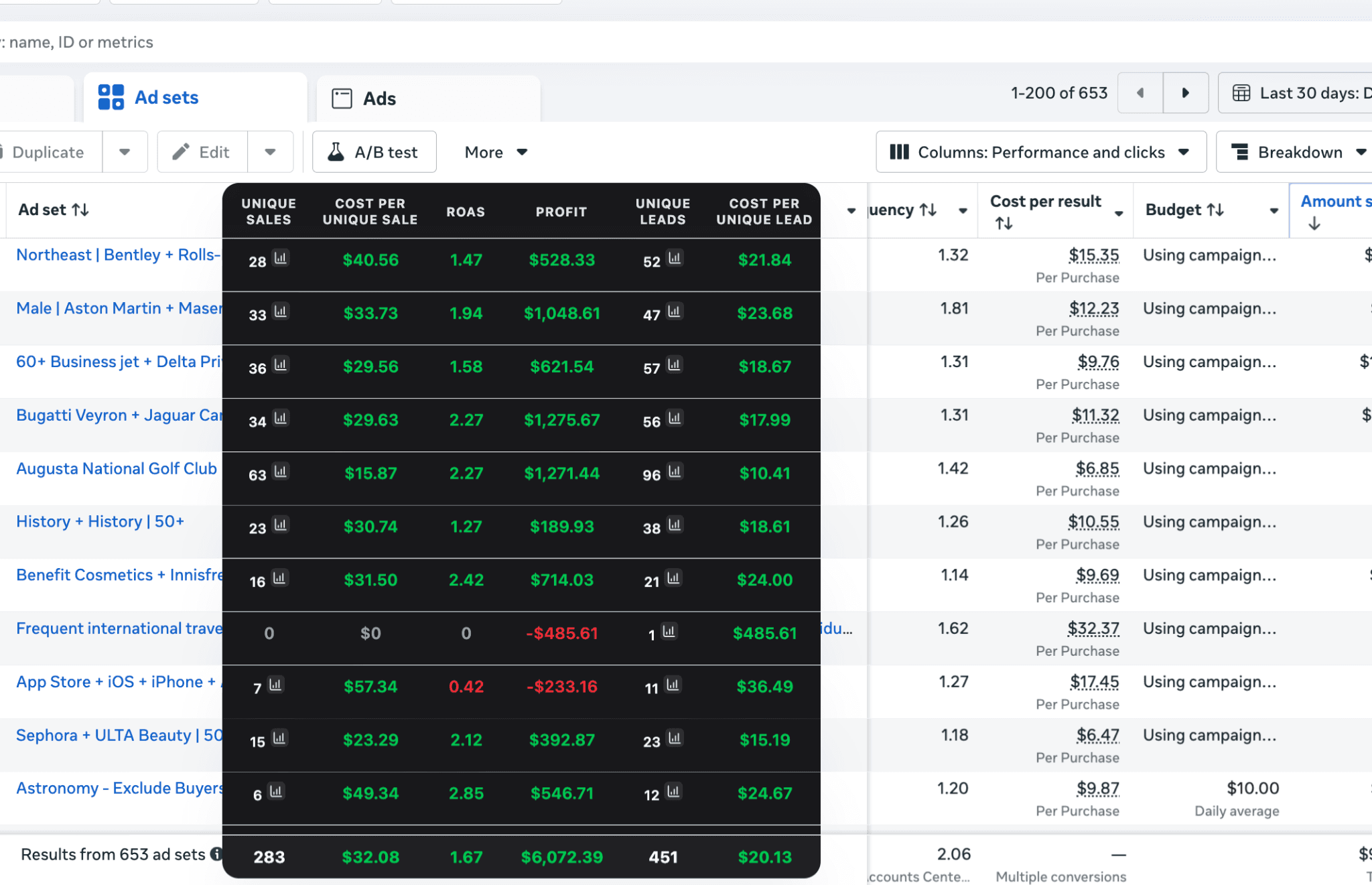
After years of context-switching between tracking dashboards and Ads Manager, I switched to Roaspy. The core difference is simple: Roaspy puts the attribution data directly inside your Ads Manager through a Chrome extension. You don't leave the tab. You don't open a second dashboard. The data is right there, next to your campaign metrics, in real time.
That alone would be enough. But the attribution accuracy is what keeps me using it. Roaspy uses FingerprintJS technology to track users across devices and sessions more accurately than cookie-based systems. In a server-side attribution comparison, Roaspy's approach catches conversions that most traditional tools miss entirely.
The CAPI integration sends accurate conversion signals back to Meta and Google Ads, which means your campaigns optimize on better data. I covered this in a recent video on my YouTube channel. Accurate tracking isn't just a reporting benefit. It directly affects how the algorithm bids and who sees your ads.
What I appreciate most for agency work is that Roaspy doesn't gate features by plan. Every tier gets full-funnel tracking, CAPI, and the Chrome extension. That's genuinely unusual. Most tools in this space either charge enterprise rates for advanced features or hide them behind upsells. When you're evaluating ClickMagick alternatives or thinking about RedTrack pricing for agencies, the total cost of capability matters.
For a full server-side attribution comparison from inside your Ads Manager with no tab-switching, Roaspy is the tool I'd put in front of any agency media buyer in 2026.
Try it at https://roaspy.com.
Frequently asked questions
Q: Is RedTrack better than ClickMagick for agencies managing multiple clients?
A: For most multi-client agencies, yes. RedTrack's Agency plan at $999/month gives you unlimited users, white-label reporting, and automation rules across 200+ integrations. ClickMagick's Pro plan at $349/month caps you at 5 users and doesn't include white-label. If client-facing reporting and automation are priorities, RedTrack pricing for agencies makes more sense at scale.
Q: What are the best ClickMagick alternatives for agencies in 2026?
A: The most common ClickMagick alternatives agencies consider are RedTrack, Roaspy, Voluum (from $119/month), and Hyros (from $230/month). The right alternative depends on your gap: if you need better automation, look at RedTrack. If you need attribution data inside Ads Manager without tab-switching, Roaspy is worth a serious look.
Q: How does server-side attribution comparison work between RedTrack and ClickMagick?
A: Both tools support CAPI for Meta and Google Ads using server-to-server postbacks, which means conversions get reported even when browser cookies are blocked. The practical difference is in setup complexity and cross-device accuracy. ClickMagick's setup is cleaner for simpler funnels. RedTrack handles more complex multi-channel environments better. Neither matches the individual-level fingerprinting that newer tools like Roaspy offer.
Q: Is ClickMagick worth it for an agency just starting out?
A: At $79/month for the Starter plan, ClickMagick is one of the most accessible entry points for clean click tracking and bot protection. For a small agency under 100k clicks/month with a tight budget, it's a reasonable starting point. Once you scale past that threshold or need multi-user access, the per-seat math gets less favorable.
Q: What does "best ad tracking for agencies 2026" actually require?
A: At minimum: CAPI integration with Meta and Google, server-side postbacks, cross-device attribution, and multi-client reporting. The best ad tracking for agencies 2026 also needs to fit into the actual workflow of a media buyer, which increasingly means living inside Ads Manager rather than requiring a separate dashboard.
Q: Can I use RedTrack and Roaspy together?
A: You can, though most agencies find one tool handles their core attribution needs. RedTrack is strong for automation rules and multi-channel data aggregation. Roaspy handles in-Ads-Manager visibility and FingerprintJS-based attribution. Some larger agencies use a combination, but for most teams, Roaspy alone covers the attribution and reporting workflow more efficiently.
My final thoughts
I've spent a lot of time on both sides of this conversation, running campaigns myself and watching how agency media buyers actually work day to day. The RedTrack vs ClickMagick for agencies debate is real, and both tools deserve credit for what they do well.
RedTrack is genuinely built for agencies. The automation rules, the white-label reporting, the workspace management. If your agency runs complex multi-channel campaigns and your media buyers have the technical bandwidth to configure it properly, RedTrack at $999/month is solid infrastructure. The server-side attribution comparison holds up, and the multi-client tooling is among the best in the category.
ClickMagick earns its reputation through reliability and protection. If your agency's bread and butter is affiliate campaigns or high-volume search where bot traffic is a real concern, ClickMagick's Guardian role is legitimate. The pricing is accessible, the setup is cleaner than most, and the 14-day trial gives you enough time to see it work.
But here's what I keep coming back to: the best tracking tool in the world doesn't help if your media buyers aren't actually using the data to make faster decisions. The workflow gap is real. And that's why I keep pointing people toward Roaspy. Not because it replaces everything RedTrack or ClickMagick do, but because it solves the problem that actually costs agencies money every single day: the gap between what your tracking tool knows and what your media buyer sees in the moment they're making a decision.
If you're serious about best ad tracking for agencies 2026, go test Roaspy at https://roaspy.com. The Chrome extension alone will change how your team operates. Everything else is upside.