1. Introduction
If you’re a coach running Facebook ads and looking for a solid Hyros alternative that won’t take a large percentage of your revenue in platform fees, there are better options available. Roaspy is one of the strongest alternatives worth considering. It’s built specifically to track booked calls from Facebook ads, connect your lead data to your calendar and CRM, and give you the call-level attribution you actually need to make smart ad decisions.
Here’s the context. Most attribution tools were built for e-commerce. They track clicks, add-to-carts, and purchases. Clean, fast, transactional. Coaching funnels don’t work like that. Someone clicks your ad, opts in, watches a VSL, books a call, gets on the phone with you three days later, and then maybe closes. Sometimes it’s two weeks later. The pixel loses track somewhere in there, and you’re left guessing which ad actually drove your last five clients. In this post, I’ll walk through why coaching funnel tracking fails, what Hyros charges and who it suits, and why I think Roaspy is the smartest move for most coaches in 2026.
2. Why coaching funnel tracking breaks down between opt-in and call
Here’s the part nobody explains clearly enough. The Facebook pixel fires on page loads. It tracks a click, maybe a lead event if you set it up right, and then it expects a purchase to happen shortly after. That model works fine for a $47 course. It completely falls apart for a $5,000 coaching program sold over a phone call.
When a lead books a call on your Calendly page, the pixel doesn’t know. When they show up to that call, the pixel doesn’t know. When your closer marks them as “won” in GoHighLevel four days later, the pixel still doesn’t know. So Facebook’s algorithm thinks your ads aren’t converting and starts pulling budget away from the campaigns that are actually filling your calendar.
This is where coaching funnel tracking turns into a genuine business problem, not just a nerdy data thing. I’ve talked to coaches running $30k to $80k a month in ad spend who had no real idea which campaigns were booking their calls. They were flying blind. And the scariest part? Some of them had “attribution tools” running. They just weren’t the right kind.
The core issue is the attribution gap: the distance between a tracked lead event and a tracked revenue event. In e-commerce, that gap is minutes. In high-ticket coaching, it can be days or weeks. Most tools aren’t built to bridge it. That’s why if you want to track booked calls from Facebook ads properly, you need something purpose-built for this exact journey, not a repurposed e-commerce tracker with a coaching skin on it.
3. What Hyros actually costs and who it’s really built for
Let me be direct about Hyros. It’s a good product. The AI-based attribution is genuinely sophisticated, the call tracking is real, and for big operations, it delivers. But the pricing model is brutal for most coaches.
Hyros typically charges a percentage of tracked revenue, usually somewhere in the range of 3% to 10%, depending on your plan. On a $200k month that’s $6,000 to $20,000 going to a tracking platform. That’s not a SaaS fee, that’s a partnership cut. And for coaches who are scaling but not yet at the level where that math makes sense, it’s a massive drag on margin.
I used to work with a client who was generating about $120k a month in his/her coaching business.. His Hyros bill was over $8,000 a month. Was the attribution good? Yes. Was it $8k a month better than a flat-rate alternative? Absolutely not.
Beyond price, Hyros has a real complexity overhead. The setup is involved, the learning curve is steep, and the support assumes you know what you’re doing. For a solo coach or a small team, that’s a lot of friction just to answer “which ad booked this call?”
That’s the gap. Coaches need the best attribution for high ticket without the enterprise price tag and the consulting-hours setup process. Hyros is built for eight-figure operators who can absorb the cost and have a media buyer dedicated to managing it. Most coaches reading this don’t fit that profile, and they shouldn’t have to.
4. The real problem: how to track booked calls from Facebook ads
Let’s get into the mechanics because I think this is where a lot of coaches get confused about what they actually need.
When someone clicks your Facebook ad, Facebook assigns them a click ID (fbclid). If you capture that click ID at the opt-in stage and attach it to the lead record, you now have a thread you can follow. Every step after that, including the booking confirmation, the no-show, the show, and the close, can be tied back to that original click. That’s the foundation of how you track booked calls from Facebook ads in a way that actually holds up.
The problem is most funnel builders and calendar tools don’t do this automatically. Calendly doesn’t natively pass the fbclid into your CRM. GoHighLevel can do it, but it needs to be set up correctly. Most coaches either don’t know this is a gap or they assume their pixel is handling it. The pixel isn’t handling it.
Server-side tracking (also called CAPI, the Conversions API) is the other piece. After iOS 14, browser-based pixels lost somewhere between 30% and 60% of their signal depending on your audience. If you’re not sending server-side events back to Facebook, you’re optimizing on incomplete data. Facebook’s algorithm is making targeting decisions based on a fraction of your actual results.
The best attribution for high ticket requires both: client-side click ID capture and server-side event firing tied to real downstream outcomes like booked calls and closed deals. Not just leads. Not just page views. Actual booked calls from Facebook ads, matched back to the ad, the ad set, and the campaign that drove them.
Honestly, this is the piece I see coaches skip most often. They set up a pixel, fire a lead event, and call it a day. Then they wonder why Facebook keeps recommending they pause their best campaign.
5. What best attribution for high ticket actually looks like in practice
I want to paint a picture of what this looks like when it’s working properly, because I think the abstract version doesn’t land.
Imagine you’re running three Facebook campaigns. One is a lead gen campaign targeting cold audiences with a VSL. One is a retargeting campaign hitting people who watched 50% of your video. One is a lookalike campaign based on past buyers. All three are driving leads to the same opt-in page and then to the same Calendly booking link.
Without proper coaching funnel tracking, you see leads coming in. Maybe 40 leads this week. Some calls get booked. A few close. But you can’t tell which campaign drove the closers. Facebook shows you cost per lead, but your cost per lead and your cost per close are completely different numbers. The retargeting campaign might look expensive per lead but close at 40%. The cold traffic might look cheap per lead but close at 8%.
With the best attribution for a high ticket properly set up, you see all of this. You see which campaign booked the most calls. You see which campaign’s calls actually showed up. You see which campaign produced revenue. And your Facebook ad account is getting accurate signals back, so the algorithm is optimizing toward people who actually book and close, not just people who opt in and ghost.
That’s not a fantasy. That’s what’s possible when coaching funnel tracking is dialed in. I’ve seen it change ad account performance dramatically. Not because the ads changed. Because the algorithm finally had the right data to work with.
The tool you use to achieve this needs to do a few specific things: capture the click ID, tie it to the lead, pass it through the booking flow, fire server-side events to Facebook for each stage, and surface all of this in a dashboard that connects back to your ads manager. That’s the full stack.
6. The tools I’ve tested as a Hyros alternative for coaches
I’ve run enough ad accounts to have tried most of the options. Here’s my honest take.
SegMetrics is solid for long sales cycles and has good CRM integration. It starts around $175/month for basic plans. It’s genuinely useful for coaching programs with email sequences and multi-touch journeys, but the call tracking piece requires setup work, and it’s not really built around the Facebook ad to booked call pipeline specifically.
Cometly is a newer player, and the UI is clean. Pricing starts around $99/month. It’s better for e-commerce than coaching funnels in my experience. The multi-touch attribution is good, but the native integration with calendar tools like Calendly is limited out of the box.
Triple Whale is mostly an e-commerce platform. I’ll be honest, I’m not sure why it keeps showing up in coaching attribution conversations. If you’re selling physical products, great. If you’re selling a $10k coaching program via a booked call, it’s not the right fit.
Wicked Reports has been around a while. Around $250/month to start. It handles longer attribution windows well, and it’s a legitimate hyros alternative for coaches who have primarily email-driven funnels. But the setup is heavy and the interface feels dated.
None of these are bad products. Most are built for adjacent use cases. The problem is that coaching funnel tracking has a very specific requirement: follow the lead from Facebook click to booked call to closed deal, and send accurate signals back to the ad platform. That specific workflow is what most of these tools handle partially but not completely.
That’s the gap Roaspy was built to close.
7. Why I recommend Roaspy for coaching funnel tracking
I started using Roaspy Ads Tracking after a frustrating month where I genuinely could not tell a client which of their three campaigns was responsible for their best-performing week. We had leads. We had calls. We had closures. We had no clean line connecting them back to ad spend. It was the kind of thing that keeps you up at night when you’re managing real money.
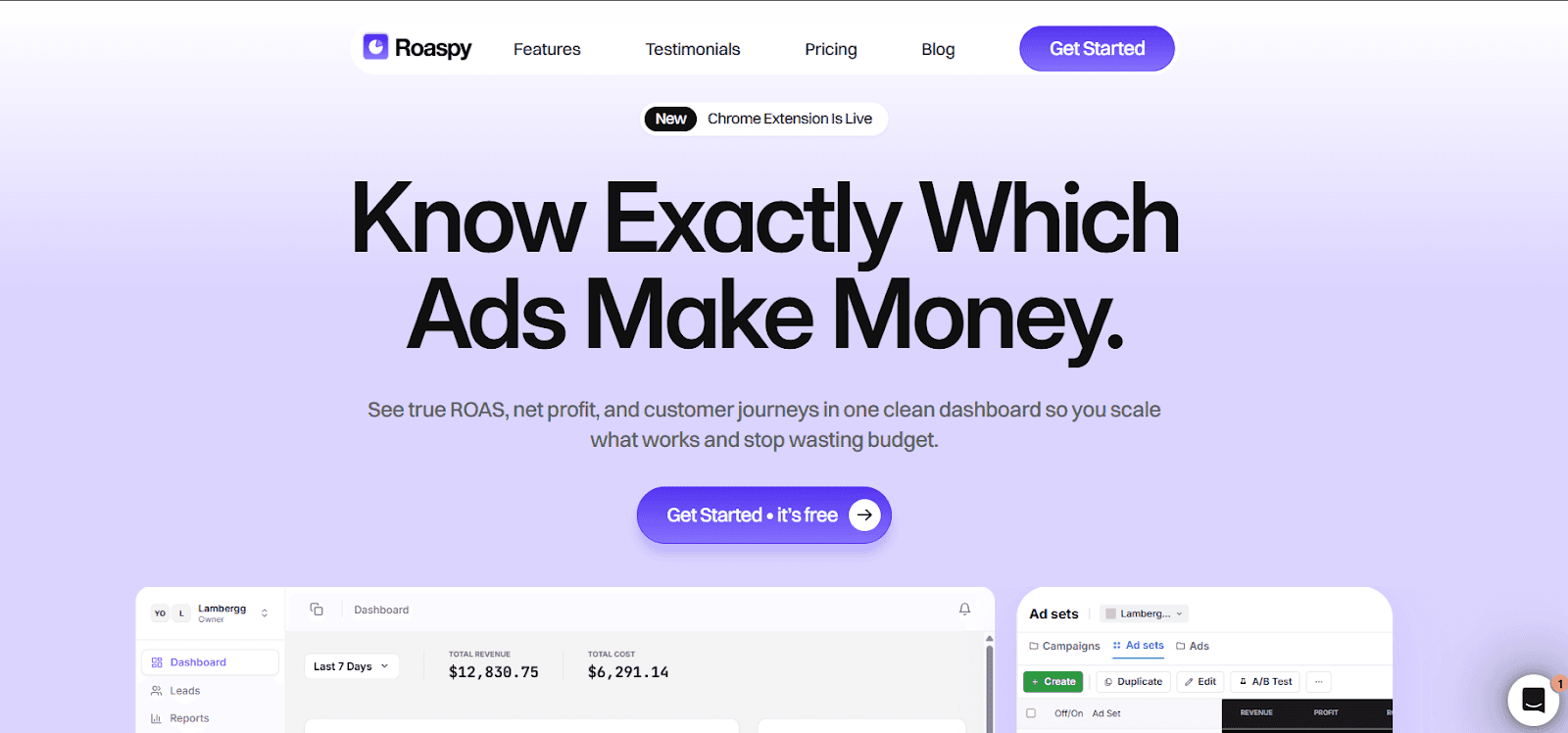
Roaspy solves the specific problem of tracking the journey from a Facebook ad click to a booked sales call, and it does it without the complexity or the revenue-percentage pricing of tools like Hyros.
Here’s what makes it different as a hyros alternative for coaches:
Lead-to-call mapping. Roaspy connects your opt-in to your Calendly or GoHighLevel booking confirmation. So when someone books a call, you know exactly which ad, ad set, and campaign drove that booking. Not just which campaign drove the lead. The actual booked call.
Server-side CAPI. iOS 14 gutted browser-based pixel tracking. Roaspy uses server-side events to restore that lost signal and send accurate conversion data back to Facebook. This alone tends to improve algorithm performance noticeably within a few weeks.
Native ads manager overlay. You can see call attribution data without leaving your Facebook Ads Manager. No tab switching, no exporting CSVs, no reconciling two separate dashboards.
Flat-rate pricing. This is the one I keep coming back to. Roaspy charges a flat monthly rate. No percentage of revenue. No surprise bills when your launch goes well. At scale, this is a significant financial difference compared to Hyros or similar revenue-based tools.
As a Hyros alternative for coaches who want the best attribution for high ticket without the enterprise overhead, it’s genuinely the most purpose-fit tool I’ve found. If you’re trying to track booked calls from Facebook ads and you want something that actually maps the full coaching funnel tracking journey, this is where I’d send you first.
You can try it at roaspy.com
8. My final thoughts
If you’ve made it this far, you probably already know you have a tracking problem. You’re spending money on ads, calls are getting booked (or not), deals are closing (or not), and somewhere between those dots is a fog that’s costing you money. Either you’re killing campaigns that are working or you’re scaling ones that aren’t. Both happen more than people admit.
The case for Hyros makes sense at a certain scale. If you’re doing $500k a month and you have a full media buying team, the sophistication is worth the price. But for most coaches, the hyros alternative for coaches conversation is really a conversation about getting best attribution for high ticket at a price that doesn’t destroy your margins.
Coaching funnel tracking isn’t a luxury anymore. It used to be something only big operators worried about. Now, with iOS privacy changes, rising CPLs, and more competition on Facebook, flying blind on attribution is genuinely dangerous. You need to know which ads are booking calls. Not leads. Calls.
I’ve built a lot of ad accounts for coaches. The ones who scaled predictably almost always had one thing in common: they knew their cost per booked call, not just their cost per lead. That single metric changed how they allocated budget, how they structured their creative testing, and how they talked to their sales team. It’s the number that actually matters.
So here’s my honest recommendation. Stop trying to track booked calls from Facebook ads with a generic pixel setup. Stop overpaying for enterprise tools built for a different kind of business. Start with something built for your specific funnel.
Try Roaspy. It’s purpose-built for this problem, it’s priced for real coaching businesses, and it gives you the coaching funnel tracking clarity you need to make confident ad decisions. Head over to roaspy.com and see if it fits what you’re building.


